Study in the UK: What It Actually Takes in 2027
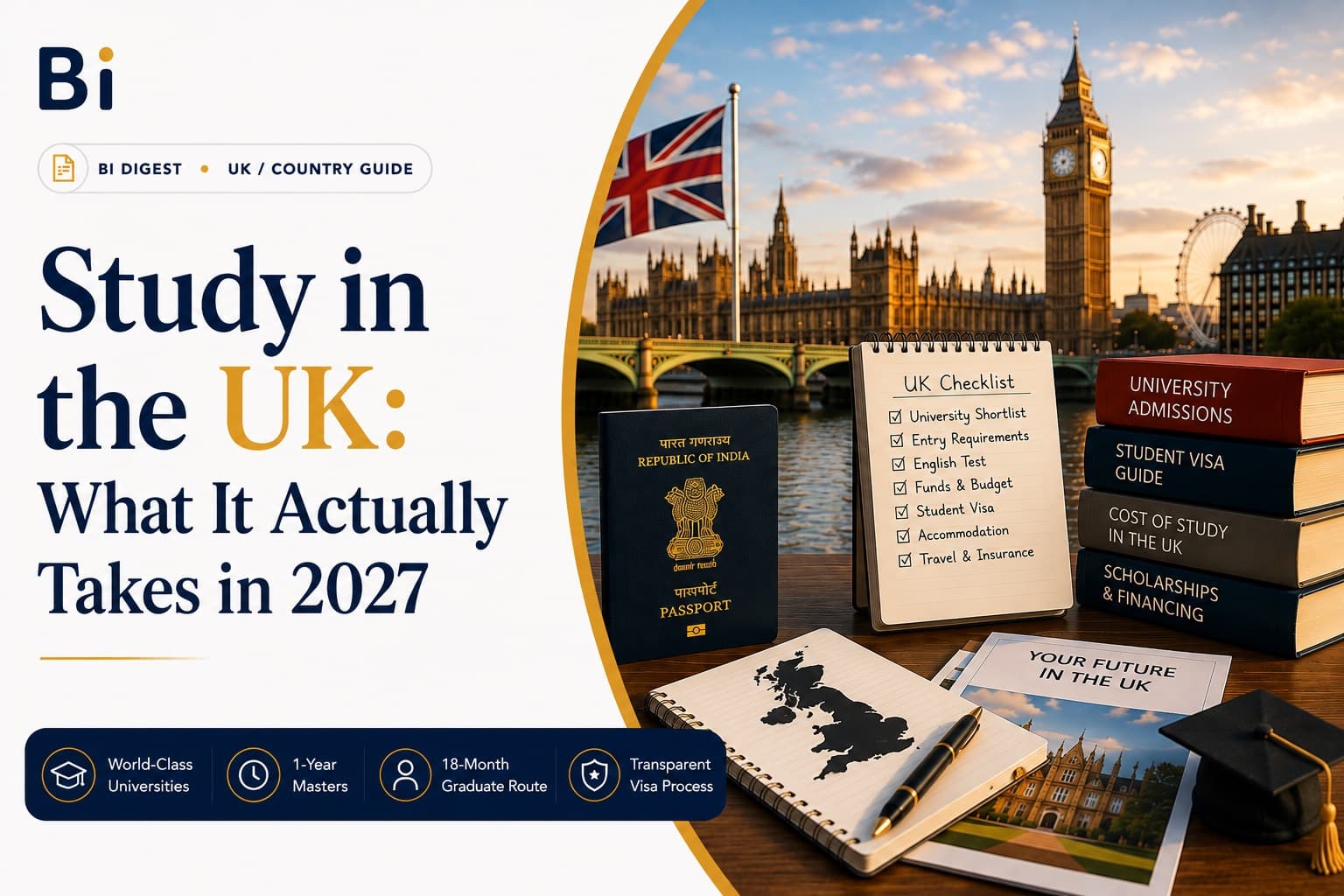
Studying in the UK from India in 2027 means budgeting £10,000-£38,000+ a year in tuition, clearing a Class 12 percentage that varies sharply by university and board, and planning around two UK policy shifts that didn't exist a year ago.
By Mandeep Aulakh · Published 19 August 2026
What it actually costs
The UK remains the destination we place the most Indian students into, and for good reason — the one-year masters, the brand recognition, and a visa system that, while it has tightened in places, is still far more predictable than several of its competitors. But most "study in the UK" guides are written generically, for any international student, when the actual application path for an Indian applicant runs through very India-specific checkpoints: board equivalency, English-test waivers most applicants don't know exist, and an intake calendar that lines up with Indian board results in ways worth planning around deliberately. Here's the UK picture as it actually applies from India, with current numbers.
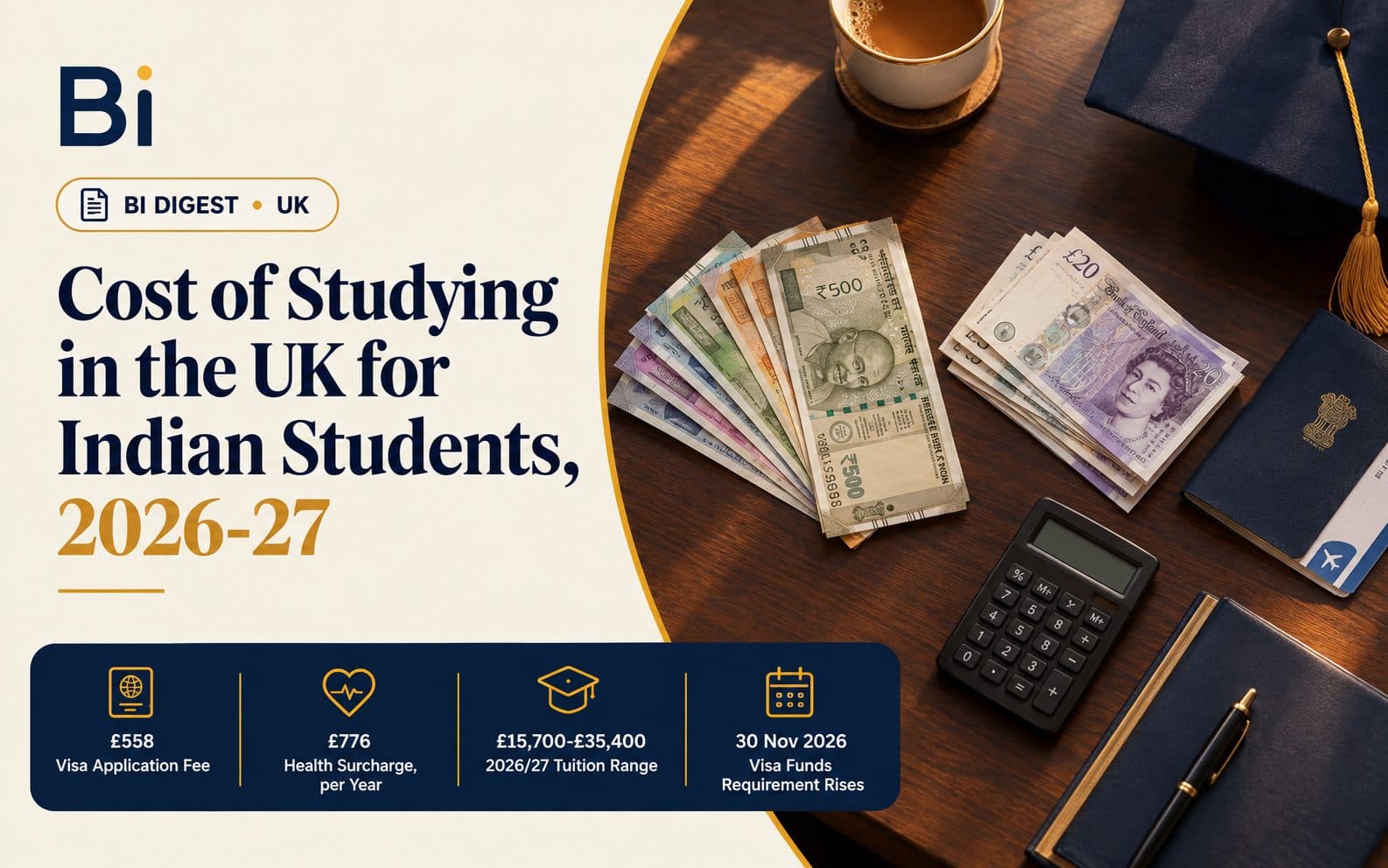
Tuition varies enormously by level, subject, and university tier, and treating "UK tuition" as one number is where most budgets go wrong. For the full first-year total in rupees, including the visa fee and the 30 November 2026 funds rise, see our UK study costs in rupees breakdown.
| Level / tier | Typical range (£) | Approx. INR* |
|---|---|---|
| Undergraduate, most universities | £10,000-£26,000/year for lecture-based courses | ₹11.5L-₹30L |
| Undergraduate, mid-range university (e.g. Lincoln) | £16,900-£22,100/year | ₹19.4L-₹25.4L |
| Undergraduate, most affordable options | From around £11,000/year (York St John, Hull, Leeds Trinity) | From ₹12.6L |
| Postgraduate taught, most universities | £15,000-£25,000/year | ₹17.3L-₹28.8L |
| Oxford (international) | £37,380-£62,820/year, medicine higher still | ₹43L-₹72.2L |
| Cambridge (international) | £29,052-£70,554/year, plus an £11,500-£14,950 annual college fee | ₹33.4L-₹81.1L |
Currency, maintenance funds, and the real Oxbridge number
*The INR column above is approximate, at roughly ₹115 per £1 — the rate moves daily, so treat it as a planning guide, not a figure to lock a budget against. Convert at the live rate before finalising any funds documentation.
Live in London, and the maintenance requirement alone runs £1,529 a month; elsewhere in the UK it's £1,171 — figures we've broken down in full, with the exact 28-day rule that trips up applicants, in our step-by-step visa guide.
The honest range for a full Oxbridge degree including living costs is a minimum of £200,000, with many students paying £350,000+ once everything is counted — that's the extreme end, not the typical one, but it's worth knowing before "Oxbridge" becomes the default target for every strong applicant. Most students land somewhere far more moderate: a one-year taught masters at a solid mid-tier university, in the £15,000-£22,000 tuition band, is the realistic centre of our placement data.
What your Indian board score actually needs to be
This is the part most UK guides skip entirely, and it's the first real gate for undergraduate applicants. Indian Class 12 qualifications — CBSE and ICSE/ISC specifically — are recognised as broadly equivalent to UK A-levels, but the percentage a specific university actually wants varies far more than most students expect:
| University tier | Typical Class 12 requirement |
|---|---|
| Most universities, general courses | 60-80% overall |
| Competitive courses generally | 75-90%, board-dependent |
| Manchester (undergraduate, general) | 80-95% overall |
| Edinburgh (undergraduate, general) | 80% overall with 75% in three subjects; CBSE and CISCE only |
| Medicine, Engineering, Law | Typically 85%+ with specific subject prerequisites |
State boards, English waivers, and the foundation-year route
State boards are treated differently, and not always transparently. Several universities publish separate, often higher, thresholds for state boards versus CBSE/ISC, and some accept only CBSE and CISCE outright rather than a full state-board list. If you're on a state board, don't assume a published "75%" requirement applies to you the same way it does to a CBSE applicant — check the specific board list on your target university's India page before you build a shortlist around it.
A detail that saves real money if you know it early: several UK universities will waive the IELTS/TOEFL requirement entirely if your Class 12 English score clears a specific threshold — commonly 70-85% in English from CBSE or ISC, sometimes higher for state boards. Surrey, for example, accepts 70% in English from CBSE/ISC and skips IELTS altogether for most courses on that basis. This isn't universal and isn't guaranteed, but it's worth checking against your actual Class 12 English mark before you assume an English test is mandatory and start booking IELTS slots you might not need. Where a test genuinely is required, most universities ask for IELTS 6.0-7.0 overall with no band below 5.5, though Oxford-tier institutions can ask for 7.0+. For how the waiver and other routes actually work, see our guide to UK universities without IELTS.
For postgraduate applicants, the equivalent gate is your bachelor's degree classification: most universities want a UK 2:1 or 2:2 equivalent, which generally translates to roughly 60%+ from a recognised Indian university for a 2:1-equivalent standard, with more selective programmes and departments setting their own thresholds — some departments give a specific allowance for graduates of IITs, top NITs, and Delhi/Mumbai/Calcutta/Pune universities even at slightly lower raw percentages, at the department's discretion.
Fall short of direct entry? Most UK universities run foundation-year pathways specifically built for this gap, often through partners like INTO or Kaplan, and roughly 30% of Indian students entering UK undergraduate study use this route rather than direct entry — it's a normal, well-trodden path, not a fallback for a weak application.
Three intakes, and why January matters more for Indian applicants specifically
The UK runs three main intakes: September, January, and May. September is the largest by far and carries the widest course selection, but January deserves more attention from Indian applicants than it usually gets, for a calendar reason: most Indian boards and universities release final results between May and July, which is workable for a September intake but leaves genuinely tight margins if anything slips — a re-evaluation request, a delayed transcript, a visa document that needs re-issuing. January is the natural pressure valve. It's a real second window with real course options, not a consolation prize, and it's specifically useful for students whose Class 12 or bachelor's results land later than planned, or whose English test score needs a retake.
Undergraduate applications for 2027 entry go through UCAS, where the centralised application fee is £28.95 for 2026 entry, rising to £34.50 for 2027 entry, covering up to five university choices. Postgraduate applications are handled directly by each university, with fees ranging £20-£150 per submission — a smaller cost individually, but one that adds up if you're applying broadly without a shortlist strategy.
Before a university issues your CAS, expect to pay an advance tuition deposit, typically £2,000-£5,000, on top of the visa fee (£558) and the Immigration Health Surcharge (£776/year) covered in detail in our visa guide.
The two policy shifts that changed the maths this year
The Graduate Route has shrunk. January 2027 is now the next available intake, and that's the cutoff: courses starting from 1 January 2027 onward get 18 months on the post-study Graduate visa instead of the 24 that applied before it, unless you're a PhD graduate, who retains the full 36 months. This is a confirmed change, not a proposal: it came out of the May 2025 Immigration White Paper and has been locked into the immigration rules. Full detail, including what it means for job-search timing, is in our dedicated Graduate Route piece.
A new levy on universities is coming, and it will likely reach your fees eventually. This is the part almost nothing published elsewhere mentions yet, because the detail only firmed up through 2026. The International Student Levy will charge UK universities £925 per international student per year, taking effect from 1 August 2028, following two no-charge trial cycles in 2026/27 and 2027/28 to let institutions prepare. It's charged to the university, not billed to you directly — but universities facing a flat per-student cost on top of nearly half already reporting deficits for 2025-26 have an obvious lever to pull, which is international tuition itself. If you're planning an entry beyond 2028, or advising a younger sibling who is, build in the expectation that fees will likely climb faster than inflation over the next few years, not just the standard annual increase.
Two smaller but real changes worth knowing: a higher standard of English (B2, up from B1) is now required for several visa routes as of January 2026, and indefinite leave to remain will require an even higher English standard from March 2027 — relevant if long-term settlement, not just study, is part of your plan.
Where the universities actually are
According to the QS World University Rankings 2027, the UK's top five are Imperial College London, Oxford, Cambridge, UCL, and Edinburgh — but rank and fit aren't the same thing, and a huge share of successful placements happen well outside that top five, into universities with strong specific departments, better city affordability, or a course structure that actually matches the applicant's goals. University of the Arts London has one of the highest international student proportions of any UK institution, at over 47% — useful to know if a strong existing international community matters to you as much as ranking does.
On cost of living by city: Lincoln was named the UK's most affordable student city in the NatWest Student Living Index 2025, and it's not the only mid-sized city offering meaningfully lower living costs than London while still delivering solid course options. If your budget is the binding constraint, city choice does as much work as university choice.
The application sequence, in order
Decide your intake before your university shortlist — September gives the widest choice, January is a legitimate alternative, not a fallback. Confirm your visa category's accepted English test before your university's preferred one, since visa offices are consistently the stricter of the two lists. Budget the full stack: tuition, the £2,000-£5,000 CAS deposit, the £558 visa fee, and roughly £776/year in IHS, before you calculate what family funds actually need to cover. Then start the maintenance-fund clock early — the UK's 28-day rule means funds assembled at the last minute is the single most common reason strong applications still get refused, a pattern we've documented in detail in our piece on why visa applications actually fail, with the prevention side covered in how to actually improve your approval odds.
The honest bottom line
The UK in 2027 is still one of the strongest destinations we place students into — the one-year masters remains a genuine time advantage over most alternatives, and even at 18 months, the Graduate Route beats what several competing destinations currently offer. But it's no longer a market where last year's numbers are close enough. Tuition bands, the Graduate Route length, and the university funding pressure created by the incoming levy are all moving at once, and a plan built on 2025 assumptions will be wrong on at least one of them. Across 800+ university partnerships and a 98.2% visa approval record, the plans that hold up are the ones rebuilt against this year's actual rules, not last year's guide.
Frequently Asked Questions
How long does the UK student visa take to process?
Around 3 weeks if you apply from outside the UK, or 8 weeks if you're extending or switching to a Student visa from inside the UK. The clock starts after your biometrics appointment. Priority processing (an extra £500) usually cuts this to around 5 working days if you need a faster decision.
How much does it cost to study in the UK in 2027?
Undergraduate tuition typically ranges £10,000-£26,000/year at most universities (from around £11,000 at the most affordable), and postgraduate taught courses run £15,000-£25,000/year. Oxford and Cambridge sit well above this, from roughly £29,000-£70,000/year depending on course.
How long is the UK Graduate Route visa now?
18 months for students starting their course from 1 January 2027 onward, down from 24 months — except PhD graduates, who retain the full 36 months. This was confirmed in the May 2025 Immigration White Paper.
Will UK tuition fees rise because of the new International Student Levy?
The £925-per-student annual levy is charged to universities, not billed to students directly, starting August 2028. But with many UK universities already facing budget deficits, it's a real financial pressure likely to feed into future tuition increases beyond standard annual rises.
When are the UK's university intakes?
Three main intakes: September (the largest, with the widest course selection), January, and May. January matters specifically for Indian applicants since most board and university results land May-July, which is workable for September but leaves little room for delays.
What Class 12 percentage do I need for a UK university as an Indian student?
It varies widely by university and board — commonly 60-80% for general courses, 75-90% for competitive ones, and 85%+ with subject prerequisites for Medicine, Engineering, or Law. CBSE and CISCE/ISC are the boards most consistently accepted; some universities set separate, often higher, thresholds for state boards, so always check your specific board against your target university's published list.
Do I need IELTS if I'm an Indian student applying to the UK?
Not always. Several UK universities waive IELTS/TOEFL if your Class 12 English score clears a set threshold — often 70-85% from CBSE or ISC, sometimes higher for state boards. Check your target university's India-specific entry page before assuming a test is mandatory. Our guide to UK universities without IELTS explains the routes.
Sources
UK tuition ranges by level and tier
Times Higher Education, Cost of Studying at University in the UK ↗University of Lincoln tuition range; named UK's most affordable student city, NatWest Student Living Index 2025
University of Lincoln, International Fees and Funding ↗Postgraduate taught tuition range
Save the Student, International Student Fees ↗Graduate Route reduced to 18 months from Jan 2027 (36 months for PhD); B2 English requirement Jan 2026; higher ILR English standard March 2027
House of Commons Library ↗International Student Levy: £925/student/year from Aug 2028, two trial cycles first
ICEF Monitor ↗Nearly half of HE providers facing 2025-26 deficits
UK Parliament, Written Questions ↗Manchester entry requirement (80-95%)
University of Manchester, India Entry Requirements ↗Edinburgh entry requirement (80% overall, CBSE/CISCE only)
University of Edinburgh, India ↗Surrey's English-score-based IELTS waiver
University of Surrey, India Entry Requirements ↗Postgraduate degree-classification equivalence
Birkbeck, University of London — India ↗GBP/INR reference rate (approximate, moves daily)
Wise, GBP to INR ↗UK Student visa processing time: 3 weeks from outside UK, 8 weeks for in-country switch/extension; priority service timing
GOV.UK, Student visa ↗Figures and rules change; always confirm against the official source for your application date.
Have a question this didn't answer?
Every situation is different. Talk to a counsellor for advice specific to your profile, budget, and timeline.