LLM in the UK for Indian Students: Fees and Entry Requirements
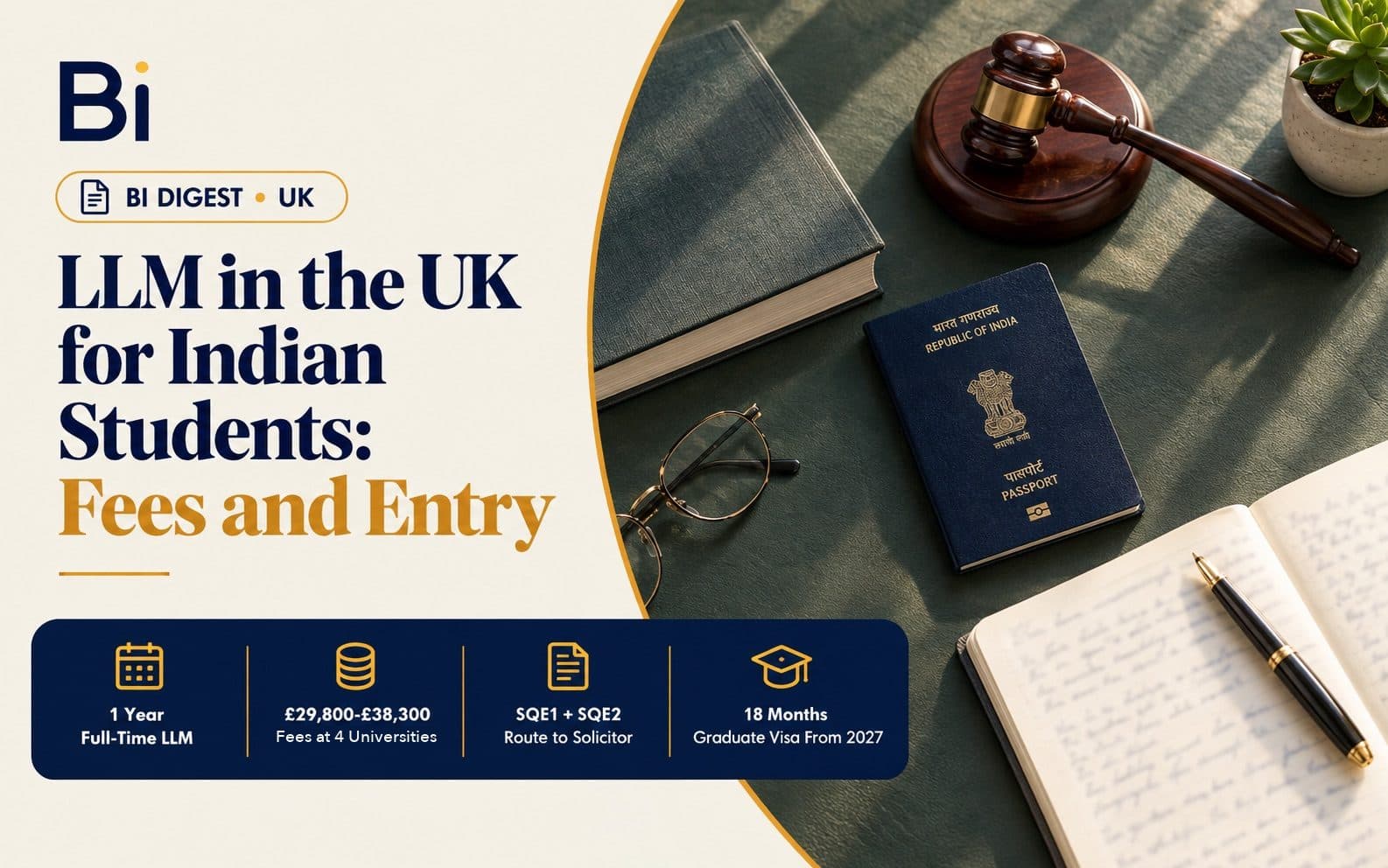
A UK LLM takes one year and costs roughly £29,800 to £38,300 at the four universities we checked. Whether you need a law degree depends on the course, and Manchester's own pages disagree with each other. Here are the fees, the entry rules and what an LLM does not do for your career.
By Mandeep Aulakh · Published 14 October 2026
The short answer: one year, £29,800 to £38,300 in fees, and an LLM is not a route to qualify as a solicitor
A UK Master of Laws (LLM) is a one-year full-time degree. At the four universities we checked, full-time international tuition runs from £29,800 to £38,300 a year, and most want a bachelor's degree at upper second class or the overseas equivalent. Whether that degree must be in law depends on the university and the course.
One point trips up many applicants. The Solicitors Regulation Authority (SRA) route to qualify as a solicitor in England and Wales does not list an LLM as a requirement. It needs a degree in any subject or an equivalent, two assessments called SQE1 and SQE2, two years of qualifying work experience and passing character checks. An LLM can deepen your knowledge, but it is not that route.
| University and course | Full-time international fee | Year the page gives | Length | Deposit |
|---|---|---|---|---|
| King's College London, LLM | £38,300 a year (part-time £19,150) | 2026/27 | Full-time or part-time | £2,000, credited toward tuition |
| University of Manchester, LLM Public International Law | £32,600 a year | 2027 entry | 1 year | £2,500, deducted from fees on registration |
| University of Edinburgh, Law (LLM), full-time | £33,600 a year (Scotland and rest of UK: £16,800) | 2027/8 | Full-time; the page says the fee shown is for one year | £1,500 for 2027-28 entry, per the law school page |
| University of Bristol, LLM International Law | £29,800 a year | Page lists a September 2027 start and does not name the fee year | 1 year full-time, 2 years part-time | Not checked |
Full-time international LLM tuition at four UK universities, from each university's own page
What the fees table does not tell you
These are four universities, not the whole market, and they are for specific courses. Fees differ by course, so a different LLM at the same university can cost something else. The years also differ: King's states 2026/27, Manchester's page shows 2027 entry, Edinburgh's fee table is for 2027/8, and Bristol's page does not name the fee year, so we have shown exactly what each page says rather than lining them up as one year.
Edinburgh's degree finder fee table for its full-time Law (LLM) shows £33,600 a year for International and EU students in 2027/8, against £16,800 for Scotland and the rest of the UK. Its law school page lists a £1,500 deposit for 2027-28 entry and a 10% discount for Edinburgh graduates. Edinburgh runs other LLM routes too, so check the fee for your own course, and check any university's own course page before you plan around a number.
Entry requirements for Indian applicants
The three universities ask for similar levels but publish different detail, and only Manchester states a figure for Indian degrees. Manchester's Law page for Indian applicants asks for a minimum overall average of 60%, or a CGPA of 3.2/4.0 or 7 to 8.0/10, in a bachelor's degree from a well-ranked institution, and does not define well-ranked. It also does not say whether a three-year or five-year law degree is accepted.
King's standard requirement is a high 2:1 bachelor's degree with a final mark of at least 65%. Its international-equivalents section on the page we read was a country selector with no listed qualifications, so we have no India-specific conversion for King's. Its English language band is B, and the application fee is £130. Bristol asks for an upper second class honours degree or an international equivalent.
| University | Degree level asked for | India-specific figure on the pages we read | Law degree required? |
|---|---|---|---|
| King's College London | High 2:1, at least 65% average (UK standard) | None found; the page used a country selector | The page lists a law degree, or a degree with at least 70% law content, as its programme-specific requirement |
| University of Manchester | First or Upper Second or overseas equivalent | 60% overall, or CGPA 3.2/4.0, or 7 to 8.0/10, from a well-ranked institution | Conflicting: see the next section |
| University of Bristol | Upper second class honours or international equivalent | None found | No. A related field such as History, Politics or International Relations is accepted |
What each university's page says about entry, for an LLM
Do you need a law degree? Manchester's two pages disagree
Manchester's Law page for Indian applicants says that for all its LLM courses, except the LLM Healthcare Ethics and Law, it requires an undergraduate law degree. But the page for the LLM in Public International Law says the bachelor's degree can be in any discipline, while noting that the LLM remains a law-focused degree.
We cannot resolve that from the pages, so treat it as a question for the admissions team before you apply. Bristol says a law degree is not required for its International Law LLM and accepts related fields. If you studied a three-year bachelor's degree outside law, the safest course is to ask the university in writing which of its LLMs will accept it.
What an LLM does and does not do for your career
The SRA's page on the Solicitors Qualifying Examination (SQE) route for England and Wales lists what you need: a degree in any subject or an equivalent level 6 qualification, both SQE1 and SQE2, two years' full-time or equivalent qualifying work experience, and passing its background checks and suitability requirements. The page does not mention an LLM. It also has a section for already-qualified lawyers, which we have not read in detail.
So an LLM is an academic degree in a chosen area of law, not a licence to practise. It does not by itself make you a solicitor in England and Wales. This article does not cover the rules for practising law in India after a UK LLM, which are set by Indian regulators, so check those directly before you choose a course.
Money, visa and work: what to plan for
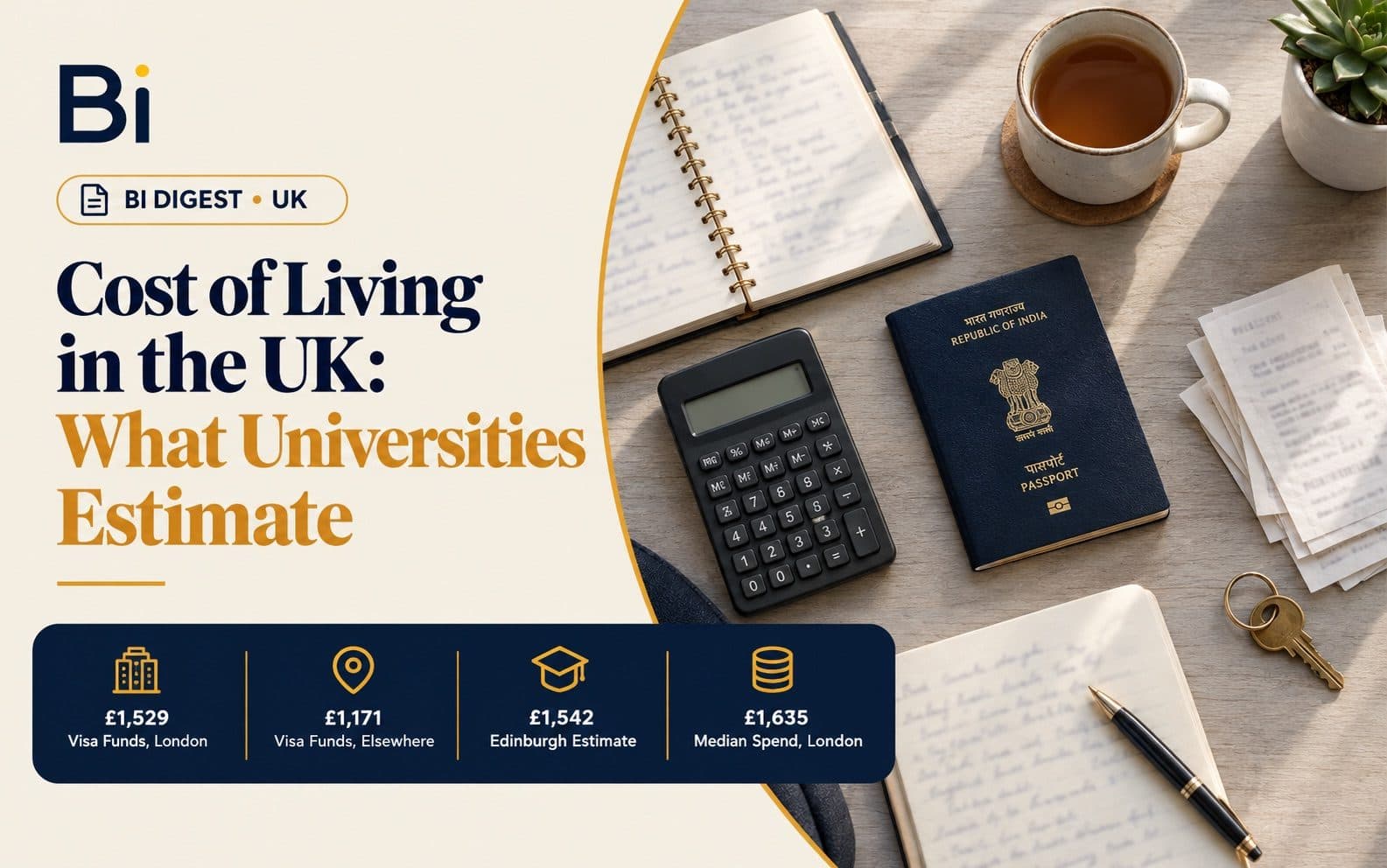
For the Student visa, the Home Office asks you to show one year of course fees plus living costs of £1,529 a month in London or £1,171 a month elsewhere, for up to 9 months, held for 28 consecutive days. King's is in London, while Manchester and Bristol are not, so the same degree can change the amount you must show. Our cost-of-living guide compares these with what universities actually estimate.
After the course, the Graduate visa lets you stay and work: 2 years if you apply on or before 31 December 2026, and 18 months if you apply on or after 1 January 2027, with a £937 application fee. While you study, a full-time degree-level course allows up to 20 hours of work a week in term time.
The honest bottom line
An LLM in the UK is a one-year, roughly £30,000 to £38,000 degree at the universities we checked, and the entry rules turn on your bachelor's degree and the specific course. It is a good fit if you want specialist legal study. It is not the route to becoming a solicitor in England and Wales, so decide your career path first, then choose the course and confirm its entry rules with the university in writing.
Frequently Asked Questions
How much does an LLM cost in the UK for Indian students?
At the four universities we checked, full-time international tuition runs from £29,800 a year (Bristol, International Law) to £32,600 (Manchester, Public International Law, 2027 entry), £33,600 (Edinburgh, Law LLM, 2027/8) and £38,300 (King's College London, 2026/27). Fees differ by course and year, so check your own course page.
How long is a UK LLM?
One year full-time. Manchester's Public International Law LLM is 1 year, and Bristol's International Law LLM is one year full-time or two years part-time. King's offers the LLM full-time and part-time.
Do I need a law degree to do an LLM in the UK?
It depends on the university and the course. Bristol's International Law LLM does not require one and accepts related fields such as History, Politics or International Relations. Manchester's Law page for Indian applicants says all its LLMs except Healthcare Ethics and Law require a law degree, while its Public International Law page says any discipline. Confirm with the university.
What marks do Indian students need for a UK LLM?
Manchester's Law page for Indian applicants asks for an overall average of 60%, or a CGPA of 3.2/4.0 or 7 to 8.0/10, from a well-ranked institution. King's asks for a high 2:1 with at least 65%, and Bristol asks for an upper second or its international equivalent. Not every university publishes an India-specific conversion.
Does an LLM from the UK let me practise as a lawyer in England?
Not by itself. The Solicitors Regulation Authority's SQE route requires a degree or equivalent, SQE1 and SQE2, two years of qualifying work experience and passing character checks, and its page does not list an LLM as a requirement. Rules for practising in India are set by Indian regulators and are not covered here.
What is the SQE?
The Solicitors Qualifying Examination, the SRA's route to qualify as a solicitor in England and Wales. You must pass both SQE1 and SQE2, complete two years' full-time or equivalent qualifying work experience, and meet the SRA's character and suitability requirements.
Can I work after a UK LLM?
You can apply for the Graduate visa, which lasts 2 years if you apply on or before 31 December 2026 and 18 months if you apply on or after 1 January 2027. The fee is £937. The visa lets you stay and work but does not by itself qualify you to practise law.
How much money must I show for a UK Student visa for an LLM?
One year of course fees plus £1,529 a month in London or £1,171 a month elsewhere, for up to 9 months, held for 28 consecutive days. Studying at a London university such as King's raises the living-cost amount you must show.
Sources
King's College London LLM full-time international fee £38,300, part-time £19,150, deposit £2,000 for 2026/27
King's College London — Master of Laws: fees, fetched 2026-10-13 ↗King's LLM entry: high 2:1 with at least 65% average, English band B, application fee £130; international-equivalent section is a country selector
King's College London — Master of Laws: entry requirements, fetched 2026-10-13 ↗Manchester LLM Public International Law (2027 entry): £32,600 international, 1 year, £2,500 deposit, First or Upper Second or overseas equivalent, any discipline
University of Manchester — LLM Public International Law, fetched 2026-10-13 ↗Manchester Law, Indian applicants: overall average 60% or CGPA 3.2/4.0, 7-8.0/10 from a well-ranked institution; law degree required for all LLMs except Healthcare Ethics and Law
University of Manchester School of Law — India entry requirements, fetched 2026-10-13 ↗Bristol LLM International Law: £29,800 full-time overseas (September 2027 start listed; fee year not named), one year full-time / two years part-time, upper second or international equivalent, law degree not required
University of Bristol — LLM Law (International Law), fetched 2026-10-13 ↗Edinburgh Law (LLM) full-time fee: £33,600 International/EU, £16,800 Scotland and rest of UK, for 2027/8; one year's fee; on-campus LLM deposit £1,500 (2027-28 entry); 10% alumni discount
University of Edinburgh — Degree finder: Taught (on campus) programme fees, Law (LLM) full-time, read 2026-10-14; and School of Law — Tuition fees and deposit policy, fetched 2026-10-13 ↗SQE route: degree in any subject or equivalent level 6 qualification, SQE1 and SQE2, two years qualifying work experience, background checks and suitability; LLM not mentioned
Solicitors Regulation Authority — Qualifying through the SQE, fetched 2026-10-13 ↗Student visa funds £1,529 a month in London, £1,171 outside London, up to 9 months, 28 consecutive days
GOV.UK — Student visa: money you need, fetched 2026-10-13 ↗Graduate visa: 2 years if applied for on or before 31 December 2026, 18 months on or after 1 January 2027; fee £937
GOV.UK — Graduate visa, fetched 2026-10-13 ↗Work conditions: up to 20 hours a week in term time for full-time degree-level study
GOV.UK — Immigration Rules: Appendix Student, fetched 2026-10-13 ↗Figures and rules change; always confirm against the official source for your application date.
Have a question this didn't answer?
Every situation is different. Talk to a counsellor for advice specific to your profile, budget, and timeline.