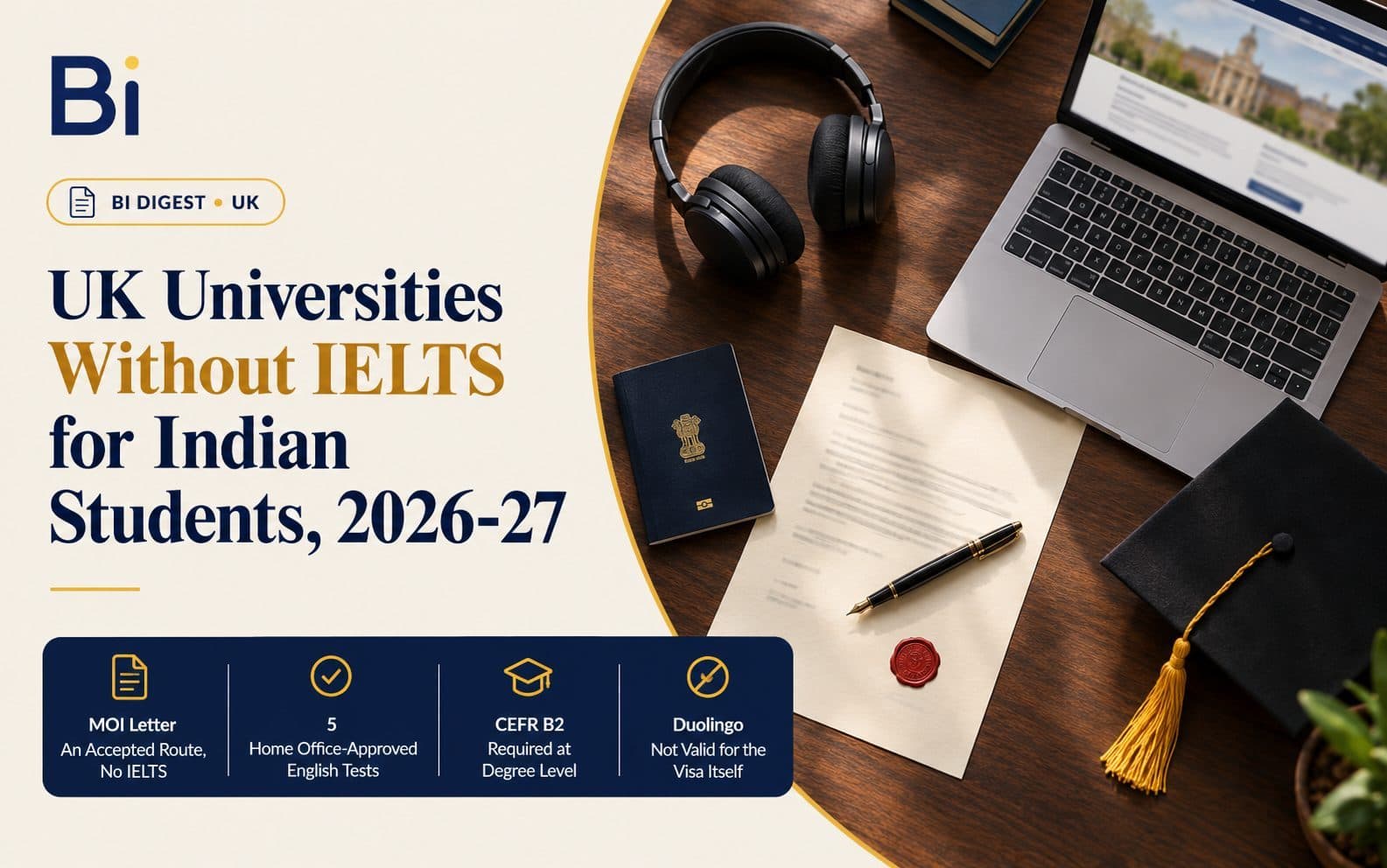
UK Universities Without IELTS for Indian Students, 2026-27
Skipping IELTS for a UK degree is real, but it is not the same as skipping proof of English. This is the actual rule — a Medium of Instruction letter or an approved alternative test — and which universities apply it, from GOV.UK and each university's own page.
By Mandeep Aulakh · Published 24 September 2026
The short answer: yes, but you still have to prove English — just not always with IELTS
You can get into a UK university and get a Student visa without ever sitting IELTS. That is real. What is not true is that you can skip proving English ability altogether -- the Home Office requires it at every degree level, with no exception for India (India is not on the UK's own 18-country list of majority English-speaking nations, so this route is not automatic the way it is for, say, a Canadian or Australian applicant).
There are two real ways round IELTS specifically: a Medium of Instruction (MOI) letter confirming your last degree was taught entirely in English, or an approved English test that is not IELTS (PTE Academic UKVI, LanguageCert, or Trinity SELT). Which one applies to you depends entirely on the university you apply to — it is a university decision, not a blanket UK policy, and it changes by course and by year.
Why some UK universities can waive IELTS at all
This is not a workaround or a loophole — it is built into the Immigration Rules. Student visa sponsors (universities licensed by the Home Office to sponsor international students) are allowed to assess an applicant's English ability themselves, instead of requiring a separate Secure English Language Test (SELT). Appendix Student says that where the sponsoring university has assessed that an applicant meets the English requirement, it must record that fact and the method used on the Confirmation of Acceptance for Studies (CAS) — the document that anchors the visa application.
In practice, this is why a university can say 'no IELTS required for this course': it is using its own right, as a trusted sponsor, to accept other evidence — most commonly an MOI letter, sometimes a non-IELTS test like Duolingo for admission purposes only — and then certifying English ability on your CAS itself, so the Home Office never asks for a separate SELT.
Separately, GOV.UK's Appendix English Language also has its own academic-qualification route (EL 5.2): a previous degree taught and assessed in English, at bachelor's level or above, can itself satisfy the requirement — which is the legal basis the MOI-letter route sits on.
Route 1: the Medium of Instruction (MOI) letter
An MOI letter is issued by the Indian college or university where you completed your last degree. It confirms, on the institution's letterhead, that your course was taught and assessed entirely in English. It is not a Home Office document and it is not submitted to UKVI directly — you give it to the UK university you are applying to, and if they accept it, they record that on your CAS.
It is not automatic. Every university that accepts MOI sets its own conditions, and they differ in ways that matter: how recently you must have graduated, which degree levels it covers (usually postgraduate taught only, not research degrees), whether it must be combined with a Class 12 English score, and whether the letter needs a physical ('wet') stamp rather than a scan. Aston University's own policy, for example, is specific: postgraduate taught courses only, a three-year recency window on your degree, English marks of 65-74% (CBSE/ISC boards) or 70-79% (State boards) at Class XII, and a wet-stamped original letter, not a scan.
| University | Degree recency required | Also needs | Scope | Source |
|---|---|---|---|---|
| Aston University | 3 years or less between end of last semester and course start | CBSE/ISC: 65-74% in English at Class XII, or State Board/NIOS: 70-79%. Wet-stamped MOI letter. | Postgraduate taught only — not postgraduate research | aston.ac.uk, international English language requirements page — fetched directly |
MOI letter policy directly confirmed on one UK university's own page (2026-09-22)
Route 2: an approved English test that is not IELTS
If a university does still want a formal test result, IELTS is not the only one the Home Office recognises. For the visa itself, GOV.UK's Secure English Language Test (SELT) list currently has five approved providers: the IELTS SELT Consortium (IELTS for UKVI or IELTS Life Skills), Pearson (PTE Academic UKVI or PTE Home), LanguageCert (three SELT variants), Trinity College London (SELT ISE or GESE), and PSI Services for applicants outside the UK. Any of these satisfies the same Home Office requirement IELTS does — the choice is yours, not fixed by nationality.
Degree-level study requires CEFR B2 across all four skills (reading, writing, listening, speaking) under the Home Office's own Appendix English Language rules, regardless of which approved test you use to prove it.
The Duolingo trap — read this before you rely on it
Many UK universities now accept the Duolingo English Test for admission. What is not true is that Duolingo satisfies the Student visa's own English requirement -- it is not on the Home Office's approved SELT list above, and it is not an MOI letter either.
The two requirements are separate and a university can treat them differently. If a university admits you on a Duolingo score alone, check explicitly whether that same university is also willing to certify your English on the CAS using that same evidence (its right under Appendix Student), or whether you will still need an MOI letter or an approved SELT before the visa stage. Assuming a Duolingo-based offer automatically clears the visa is the single most common mistake in this whole area — confirm it in writing from the university's own admissions or international office, not from a forum thread.
What still trips people up
MOI acceptance is rarely a blanket, university-wide policy — it is usually scoped to postgraduate taught courses, not undergraduate or postgraduate research, and it is reassessed at the admissions team's discretion even where a university publishes general criteria. A stale degree (more than two or three years old, depending on the university) can fail the recency test even if it was fully English-medium.
A wet-stamped, original-letterhead MOI letter is a hard requirement at some universities (Aston is explicit about this) — a scanned or self-attested version can be rejected outright, so this is not something to leave until the CAS deadline.
None of this is fixed for more than a year at a time. Every university reviews its English-language policy for each new intake, so a 2024 or 2025 blog post claiming a university 'accepts MOI' is not proof it still does for 2026-27 entry — check the live page on the university's own site for the intake you are actually applying to.
How to check before you commit
Search the specific university's own international-student or English-language-requirements page for the exact phrase 'Medium of Instruction' — most that accept it publish the conditions in full. If it is not there, email the international admissions office directly and ask two separate questions: whether MOI is accepted for your specific course and intake, and whether an approved SELT (not Duolingo) would be needed regardless. Get the answer in writing before you skip test preparation altogether — a rejected MOI letter close to the CAS deadline is one of the few genuinely hard-to-recover situations in a UK application timeline.
The honest bottom line
IELTS-free is a real and common path for Indian students applying to UK universities, built on a genuine right universities have under the Immigration Rules — it is not a myth or a marketing claim. But it is university-specific, course-specific, and time-bound, and it never removes the underlying requirement to prove English ability altogether. Treat 'no IELTS' claims — including this one — as a starting point to verify directly with the university for your exact course and intake, not as a guarantee.
Frequently Asked Questions
Can Indian students get a UK student visa without IELTS?
Yes, but only by using one of two accepted alternatives: a Medium of Instruction (MOI) letter confirming your last degree was taught in English, or a different Home Office-approved English test such as PTE Academic UKVI, LanguageCert or Trinity SELT. English proof itself is never optional — India is not on the UK's majority-English-speaking country list.
What is a Medium of Instruction (MOI) letter?
An MOI letter is issued by your previous Indian college or university on its own letterhead, confirming your degree was taught and assessed entirely in English. You submit it to the UK university you are applying to, not to UKVI directly — if accepted, the university records it as your English evidence on your Confirmation of Acceptance for Studies (CAS).
Which UK universities accept MOI letters from Indian students?
Policies vary by university and are reset each intake, and claims about which universities accept MOI circulate widely online without always being current. Aston University confirms a detailed MOI policy directly on its own admissions page as of 2026-09. Several other universities are commonly reported to accept MOI, but always confirm current terms directly on the specific university's own page for your intake — third-party lists are not a substitute.
Does an MOI letter need to be an original stamped document?
At some universities, yes. Aston University explicitly requires a wet-stamped letter on the awarding institution's headed paper, not a scan or self-attested copy. Check the exact submission format required before your CAS deadline, since a rejected MOI letter late in the process is hard to recover from in time.
Does Duolingo English Test satisfy the UK student visa requirement?
No. Over 100 UK universities accept Duolingo for admission, but it is not on the Home Office's approved Secure English Language Test (SELT) list, so it does not by itself satisfy the visa's English requirement. Confirm in writing whether your university will separately certify your English for the CAS, or whether you still need an MOI letter or approved SELT.
What English tests does the UK Home Office actually accept for a Student visa?
Five providers are currently approved: the IELTS SELT Consortium (IELTS for UKVI or IELTS Life Skills), Pearson (PTE Academic UKVI or PTE Home), LanguageCert, Trinity College London (SELT ISE or GESE), and PSI Services for applicants outside the UK. Any one of these meets the same requirement IELTS does.
What CEFR English level is required for a UK bachelor's or master's degree?
CEFR B2 across all four skills — reading, writing, listening and speaking — is the Home Office's baseline for degree-level study (RQF level 6 and above) under Appendix English Language, whichever approved route you use to prove it.
Can postgraduate research (PhD) students use an MOI letter?
Often not on the same terms as taught postgraduate courses. Aston University, for example, explicitly limits its published MOI policy to postgraduate taught programmes and excludes postgraduate research — check your specific course's requirements rather than assuming a taught-course MOI policy extends to a PhD, and don't assume every university's scope matches Aston's.
How old can my previous degree be for an MOI letter to still count?
It depends on the university, and there is no single UK-wide rule. Aston University, one of the few with a policy confirmed directly on its own page, requires three years or less between the end of your last semester and your UK course start date. Always check the exact window on your target university's own admissions page, not a third-party list.
Is 'no IELTS required' the same as 'no English requirement'?
No. It means the university accepts a different form of evidence — an MOI letter or a non-IELTS approved test — in place of IELTS specifically. Every Indian applicant for a UK Student visa still has to prove English ability at the CEFR B2 level for degree-level study; there is no exemption based on nationality.
Sources
Majority English-speaking country list under Appendix English Language does not include India
GOV.UK — Immigration Rules Appendix English Language ↗Academic qualification route (EL 5.2): a previous degree taught and assessed in English can satisfy the English requirement
GOV.UK — Immigration Rules Appendix English Language ↗Approved SELT providers and tests: IELTS for UKVI/IELTS Life Skills, PTE Academic UKVI/PTE Home, LanguageCert, Trinity SELT, PSI Skills for English
GOV.UK — Prove your English language abilities with a SELT ↗Student sponsors (universities) may self-assess English ability and must record the method on the CAS, instead of requiring a SELT
GOV.UK — Immigration Rules Appendix Student ↗Aston University MOI letter policy: 3-year recency window, wet stamp required, CBSE/ISC and State Board thresholds, postgraduate taught only
Aston University — English Language Requirements ↗Duolingo English Test accepted for admission at many UK universities but not on the Home Office SELT list
GOV.UK SELT list (absence of Duolingo) cross-checked against published university admissions pages ↗Figures and rules change; always confirm against the official source for your application date.
Have a question this didn't answer?
Every situation is different. Talk to a counsellor for advice specific to your profile, budget, and timeline.