UK's New CAS Rule for Agent-Based Applications, Explained
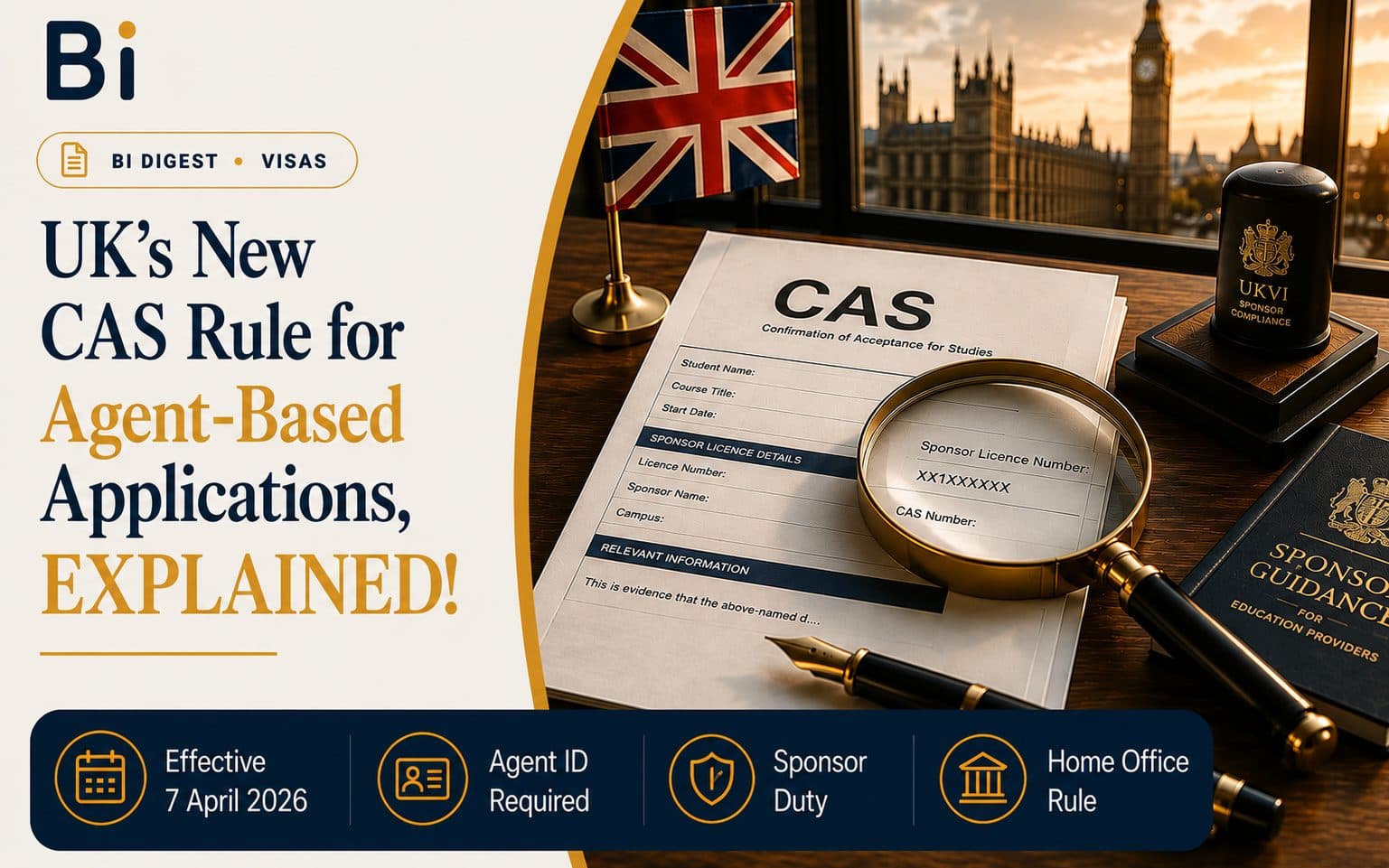
Since 7 April 2026, every UK university sponsoring your student visa must record the specific education agent it used to recruit you directly onto your CAS — legal name, country of registration, and business ID — even if the arrangement was a one-off with no formal contract.
By Mandeep Aulakh · Published 18 August 2026
What actually changed
The updated Student Sponsor Guidance, Document 2 ("Sponsorship Duties"), took effect from 7 April 2026, and it added a specific new duty: sponsors must record agent details on the CAS wherever an agent was used in recruiting that student — full stop. This applies even to a one-off recruitment with no ongoing formal contract between the university and the agent. If a sub-agent was involved, the university must record the main agent's details, not the sub-agent's.
There's one clean exception worth knowing: if you engaged an advisor directly yourself — not someone the university itself used as part of its recruitment process — that advisor's details don't need to appear on your CAS. The rule targets the university's own recruitment channel, not any support you independently sought.
Why the Home Office actually did this
The measure came out of a Migration Advisory Committee recommendation, following a documented surge in visa refusals linked to fraudulent documentation supplied by unscrupulous agents. By capturing agent identity at the source — on every CAS, not just in an annual sponsor return — the Home Office aims to build what's effectively a "bad-actor" list, which could be shared with universities as early as 2027 and used to flag or refuse applications connected to agents with a pattern of compliance breaches.
This is a genuinely different mechanism from the old rule, which only required universities to declare their agent relationships once a year as part of their sponsor licence renewal. Tracking it per-CAS means the Home Office can now trace fraud patterns back to a specific agent across many different students and universities, rather than relying on each institution to self-report problems separately.
What it means for universities, and indirectly for you
The consequences for universities that get this wrong are real. Sponsors that fail to provide complete agent information risk being downgraded to a B-rating, which freezes new CAS issuance entirely, or losing their sponsor licence altogether. Universities are also now expected to formally commit to the Agent Quality Framework (AQF) and be able to demonstrate that compliance — not just claim it.
The practical effect for students: some universities have already updated their agent contracts to require proof of business registration and mandatory anti-fraud training before an agent can recruit on their behalf. That's a genuinely good development if you're applying through an agent — it means the university itself now has a direct financial and licensing incentive to only work with agents who follow the rules, rather than treating agent quality as someone else's problem.
Why this matters if you're choosing who to apply through
This rule doesn't change your application form, your documents, or your visa fee. But it's a useful signal for a decision you're already making: which agent or consultancy to trust with your UK application. An agent that a university is willing to name, formally, on a government-tracked document, submitting to registration checks and anti-fraud training as a condition of that relationship, is operating under real accountability. An unregistered or informally-arranged "friend of a friend" arrangement carries none of that — and under this rule, if something goes wrong with that recruitment path, it's now traceable in a way it wasn't before, which cuts both ways: it protects genuine students from fraud, but it also means using a disreputable agent now carries a documented trail connected to your specific CAS.
This sits alongside the broader compliance tightening UK universities are under this year — February 2026 Home Office data showed 426,471 sponsored study visas granted in the year to December 2025, up 3% on the previous year, even as institutions face increasing pressure to pre-screen applications more aggressively before ever issuing a CAS. The agent rule is one piece of a wider pattern: visa refusal rates are increasingly linked directly to institutional compliance ratings, which gives every university a direct incentive to only sponsor applications — agent-recruited or otherwise — that are genuinely solid.
Frequently Asked Questions
Do I need to do anything differently because of the new CAS agent rule?
No — this is a university-side administrative duty. You submit the same documents you always would. The change is that your university must now record the specific agent it used to recruit you, if any, directly on your CAS.
When did the UK's CAS agent-tracking rule take effect?
7 April 2026, via an update to the Home Office's Student Sponsor Guidance (Document 2: Sponsorship Duties).
Does this rule apply if I found my own independent education consultant?
No — it only applies to agents the university itself used as part of its recruitment process. An advisor you engaged independently, who wasn't part of the university's own recruitment channel, doesn't need to be recorded.
What happens to a university that doesn't comply with the agent rule?
It risks a compliance downgrade that freezes new CAS issuance, or losing its sponsor licence entirely — both of which directly affect the university's ability to admit international students at all.
Sources
Rule effective 7 April 2026; agent details required on CAS, even for one-off/no-contract recruitment; sub-agent rule; independent-advisor exception
Home Office, Student Sponsor Guidance Document 2 (Sponsorship Duties), Version 04/2026 ↗Rule effective 7 April 2026; agent details required on CAS, even for one-off/no-contract recruitment; sub-agent rule; independent-advisor exception
St Andrews Cambridge, official guidance excerpt ↗Agent Quality Framework compliance requirement
ICEF Monitor, UK Home Office publishes updated visa sponsor guidance ↗426,471 sponsored study visas granted, year to Dec 2025 (+3%); compliance-linked refusal pressure
VisaVerge, UK Tightens Student Visa Rules in 2026 ↗Figures and rules change; always confirm against the official source for your application date.
Have a question this didn't answer?
Every situation is different. Talk to a counsellor for advice specific to your profile, budget, and timeline.