Cost of Studying in the UK for Indian Students, 2026-27 (in ₹)
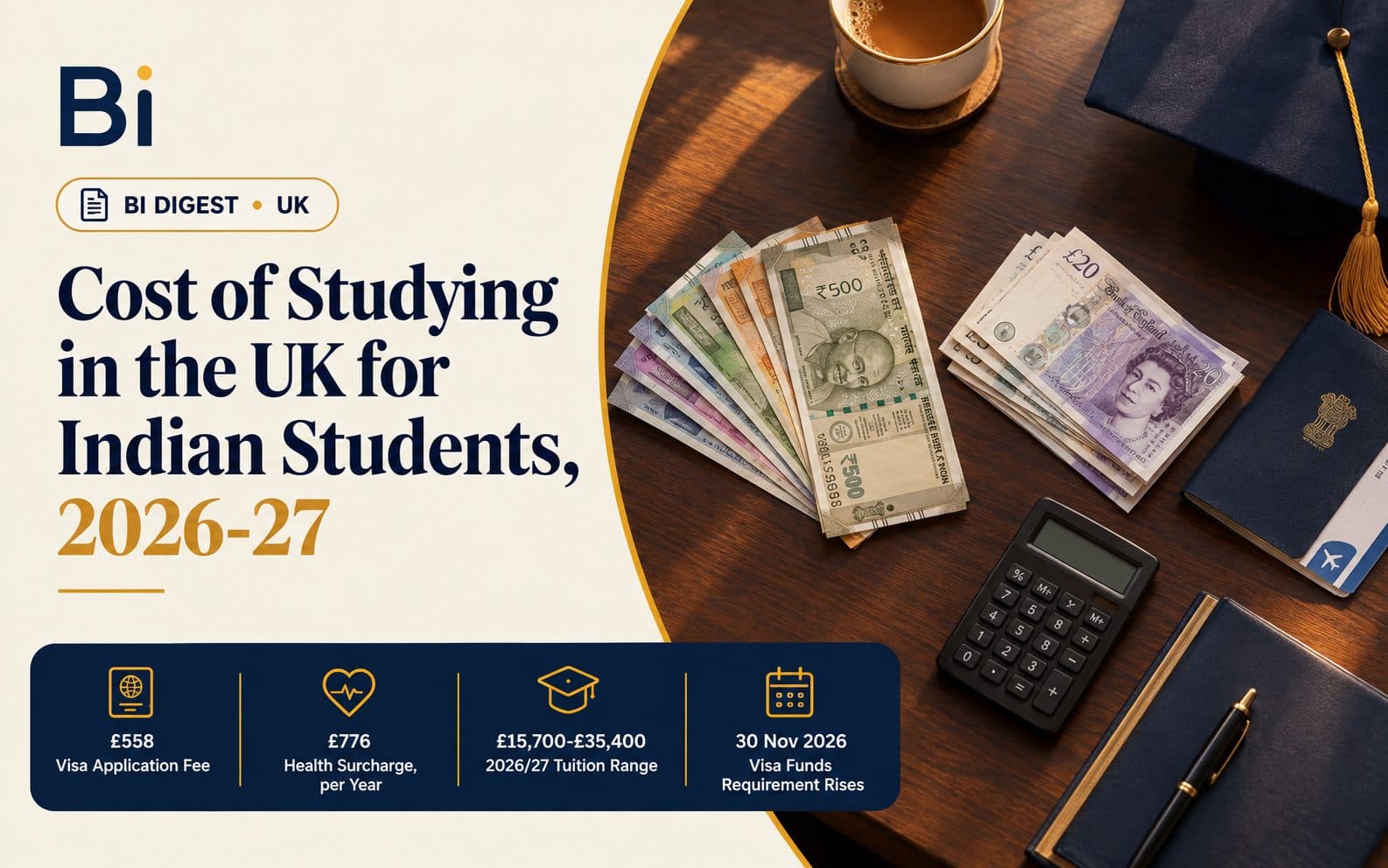
A one-year UK master's costs an Indian student roughly ₹36.2 to ₹65.6 lakh in the first year, and the visa funds rule changes on 30 November 2026. Here is every line of that number, from official sources, in rupees.
By Mandeep Aulakh · Published 22 September 2026
The short answer: roughly ₹36.2–₹65.6 lakh for a one-year UK master's
A one-year UK master's costs an Indian student roughly ₹36.2 to ₹65.6 lakh in total for the first year in 2026-27, at about ₹128 to the pound. That covers tuition, the £558 visa fee, the health surcharge and nine months of living costs held as visa funds. Tuition and whether you study in London drive most of the difference.
The four scenarios below use real 2026/27 tuition fees from university pages, the current GOV.UK visa fee and health surcharge, and the visa maintenance figure that applies to applications made from 30 November 2026 (£1,203 a month outside London, £1,570 in London, for nine months).
| Scenario | Tuition | Visa fee + health surcharge | Nine months' living costs (visa funds) | Total | Total in ₹ |
|---|---|---|---|---|---|
| Budget, outside London (University of Bradford, standard classroom-based master's) | £15,700 | £1,722 | £10,827 | £28,249 | ₹36.2 lakh |
| Mid-range, outside London (University of Kent, MSc Data Science) | £23,500 | £1,722 | £10,827 | £36,049 | ₹46.1 lakh |
| Higher, outside London (University of Manchester, MSc Data Science) | £35,200 | £1,722 | £10,827 | £47,749 | ₹61.1 lakh |
| Higher, London (UCL, MSc Knowledge, Information and Data Science) | £35,400 | £1,722 | £14,130 | £51,252 | ₹65.6 lakh |
First-year cost of a one-year UK master's, 2026-27 (₹ at about ₹128 per £)
What the table leaves out
The table covers year one on the visa rules, not every rupee you will spend. The nine-month cap is a visa rule, not a budget: a twelve-month master's means about three more months of living costs, which at the visa rate outside London is £3,513 (about ₹4.5 lakh). Flights and one-off setup costs are also extra.
Exchange rates matter as well. A 5% swing on the £36,049 mid-range total is about £1,802, or roughly ₹2.3 lakh. The rate used here is the mid-market rate on 21 September 2026 (about ₹128.3 to ₹128.9 per £); your bank's rate will be slightly worse.
You may also see lower UK figures in general study-abroad comparisons, including our own multi-country cost guide. Those typically show tuition and living costs at the low end of a range. The totals here are what you need to have ready for year one, including the visa charges and the funds you must hold.
Tuition: the same kind of degree ranges from £15,700 to £35,400
For a master's in data science or a similar computing subject, 2026/27 international tuition runs from about £15,700 at a budget-tier university to about £35,400 at a London research university. Tuition is the biggest cost lever you control, far bigger than anything on the visa side.
| University | Programme | International fee | Note |
|---|---|---|---|
| University of Bradford | Standard classroom-based master's (fee band) | £15,700 | Lab-based master's band is £19,500. Check which band your course falls in. |
| Coventry University | MSc Data Science | £19,500 | 1 year full-time. An optional placement route runs up to 2 years and adds a £1,900 placement fee. |
| University of Kent | MSc Data Science | £23,500 | 1 year full-time. |
| University of Manchester | MSc Data Science (all four pathways) | £35,200 | A £2,500 deposit is due before a CAS is issued to self-funded international applicants. |
| UCL | MSc Knowledge, Information and Data Science | £35,400 | UCL's other data-science MScs run higher, for example £39,200 for Data Science and Public Policy (Economics). |
International tuition, 2026/27 entry, one-year master's in data science or nearest equivalent
Why the fee band matters more than the university's name
Fees are set per programme and vary a lot inside one university, so treat the table as a yardstick, not a price list. The gap between Bradford's classroom-based and lab-based bands is £3,800 (about ₹4.9 lakh), and the gap between Kent and Manchester on the same subject is £11,700 (about ₹15.0 lakh).
Business and management degrees cost more again: a UK MBA runs from about £50,000 to £123,950, which we break down in our UK MBA guide. Placement routes change the maths in two ways, a placement fee and a second year of living costs, so a two-year route is not just the one-year price plus a small extra.
Read the fee line on your specific course page for the exact 2026/27 year. Some universities can raise fees during a multi-year course, so check each one's stated policy before you commit.
Scholarships: what each of these five universities actually offers
Skip generic scholarship lists from other universities and check what the five schools in the table above actually offer, since a real, automatic award at your own university is worth more than a famous one you compete nationally for.
Bradford gives Indian nationals a £3,500 automatic fee reduction, the Vice-Chancellor's Award for Indian Students, on most full-time courses (MBA and distance learning excluded) — no separate application, and it renews each year if you keep a 60%+ average. Kent gives India-domiciled applicants to postgraduate taught, full-time programmes an automatic £5,000 (£3,000 for Kent Business School specifically), again with no application. Coventry offers its Group Scholarship, a straightforward £2,000-a-year fee reduction for self-funded international students on taught full-time postgraduate courses, though it cannot be combined with any other award.
Manchester and UCL run competitive, named scholarships rather than automatic discounts. Manchester's Global Futures Scholarship is a partial-merit award open to applicants from 23 listed countries, India among them. Manchester's separate GREAT Scholarships, funded through the national British Council programme, are restricted by the university to Bangladesh, Ghana and Pakistan specifically — India sits in the wider national GREAT Scholarships programme, but Manchester itself does not extend this particular award to Indian applicants, so skip it if you're applying from India. Alliance Manchester Business School runs a separate scheme worth £18,000 for African applicants and £10,000 for other international markets; its own page does not name which countries fall into the second tier, so confirm directly with Alliance MBS before counting on it. UCL's Global Master's Scholarship is worth £15,000, applied to tuition first with any remainder paid toward living costs in three instalments — of 85 awards university-wide in 2026/27, five were ring-fenced specifically for Indian applicants.
Applied to the Kent scenario from the table above (£36,049, ₹46.1 lakh), Kent's own £5,000 automatic award brings the total to £31,049 (about ₹39.7 lakh) with no application needed at all.
The timing problem most guides don't mention
Named, competitive scholarships close months before the intake they fund, and several of the ones above have already closed for a September 2026 start by the time most students are deep into visa and cost planning: UCL's Global Master's Scholarship deadline was 7 May 2026, and Kent's GREAT Scholarship deadline has also passed for this cycle. If you're planning a January 2027 or September 2027 start, don't assume the same award is still open on the same terms — check the specific scholarship's current page for its next deadline, and confirm it actually covers your intake month, since some named awards are September-only.
Chevening and Commonwealth, the two most-searched UK scholarship names, follow the same pattern and are easy to misjudge on timing. Chevening needs at least two years' work experience (2,800 hours) after your undergraduate degree and covers tuition, living costs and return airfare in full; its window for the cohort starting September 2027 runs to 6 October 2026. Commonwealth Shared Scholarships need a first degree of at least upper-second-class (2:1) honours, are jointly funded with the host university rather than fully government-funded, and applications for 2026/27 entry are already closed — the next realistic target is the following cycle. Automatic awards like Bradford's, Kent's and Coventry's above don't have this problem, since there's no competitive deadline to miss.
Visa costs: £558 plus the health surcharge
The UK Student visa costs £558 when you apply from outside the UK (about ₹71,424), and the Immigration Health Surcharge is £776 per year of visa (about ₹99,328 a year), paid as part of the same application. For a one-year master's, budget about £1,164 (about ₹1.5 lakh) for the surcharge, because the visa usually runs a few months past the course.
The surcharge is charged in six-month blocks, rounded up. A 16-month visa is therefore charged as 18 months: £776 for the first year plus £388 for the extra half year. Use the government's surcharge calculator for the exact figure on your visa length. Both charges are paid at application, so they belong in your upfront cash, not your monthly budget.
Living costs and visa funds: what changes on 30 November 2026
To get a UK Student visa you must show your course fees plus £1,529 a month in London or £1,171 a month elsewhere, for up to nine months, held for 28 days in a row. On 30 November 2026 those monthly figures rise to £1,570 and £1,203, so an application made from that date needs £369 (London) or £288 (elsewhere) more.
| Until 29 Nov 2026 | From 30 Nov 2026 | Nine-month total, old | Nine-month total, new | Increase | |
|---|---|---|---|---|---|
| London | £1,529 a month | £1,570 a month | £13,761 | £14,130 | £369 (about ₹47,232) |
| Outside London | £1,171 a month | £1,203 a month | £10,539 | £10,827 | £288 (about ₹36,864) |
UK Student visa maintenance requirement, before and after 30 November 2026
How the rise happens, and why it will not be the last
The increase comes from the Statement of Changes to the Immigration Rules, HC 584, published on 3 September 2026. It ties the visa figure to the maintenance loans available to UK students for 2026/27, and the government has said it will keep it aligned in future, so expect further annual rises.
Many applicants for a January 2027 start will apply after 30 November, especially those still waiting on a CAS. If that is you, budget to the new figures, not the ones still quoted in older guides.
The visa figure is a floor, not a forecast of what you will spend. Published estimates of real monthly living costs run roughly £1,300 to £2,000 in London and £900 to £1,400 elsewhere, depending on accommodation and lifestyle, so treat the visa amount as a planning minimum, not a comfortable London budget. London also costs more on the visa scale alone: over nine months its requirement is £3,222 higher than outside London (about ₹4.1 lakh).
What actually moves your total
Five choices move a UK master's budget the most: where you study, which fee band your course sits in, whether you take a placement year, when you apply relative to 30 November, and when your money changes from rupees to pounds.
Location: London adds about ₹4.1 lakh in visa funds alone. Fee band: Bradford's lab-based band is £3,800 above its classroom band. Placement: Coventry's placement route adds a £1,900 fee plus a second year of living costs. Timing: applying after 30 November adds £288 to £369 in funds you must show. Deposits: Manchester asks self-funded international applicants for £2,500 (about ₹3.2 lakh) before it issues a CAS, so that cash is needed earlier than the tuition instalments.
The honest bottom line
For most Indian students the realistic first-year budget for a one-year UK master's is between ₹36.2 and ₹65.6 lakh, and tuition, not the visa charges, decides where in that range you land. Compare four or five universities on the same type of programme before you shortlist, and read each course page's fee line for 2026/27.
If your budget sits near the low end, outside-London universities with classroom-based master's bands are where the numbers work. If you are aiming at a London research university, plan for the higher visa funds and a tuition figure above £35,000 from the start. Either way, keep the funds untouched for 28 days before you apply.
Frequently Asked Questions
How much does it cost to study in the UK for Indian students?
A one-year UK master's costs roughly ₹36.2 to ₹65.6 lakh in the first year in 2026-27, at about ₹128 per £. That includes tuition (£15,700 to £35,400 in our examples), the £558 visa fee, the health surcharge and nine months of visa funds. London and higher fee bands sit at the top of the range.
What is the UK student visa fee in 2026?
The UK Student visa costs £558 when you apply from outside the UK, which is about ₹71,400 at ₹128 per £. This applies to applications made from 8 April 2026; it was £524 before that, so older guides underquote it. You pay the Immigration Health Surcharge separately as part of the same application.
How much is the UK Immigration Health Surcharge for students?
The surcharge is £776 per year of visa for students, about ₹99,300 a year. It is charged in six-month blocks, rounded up, so a 16-month master's visa is charged as 18 months: £1,164, or about ₹1.5 lakh. It is paid upfront with your visa application.
How much money must I show for a UK student visa?
You must show your course fees plus living costs of £1,529 a month in London or £1,171 a month elsewhere, for up to nine months, held for 28 days in a row. From 30 November 2026 the monthly figures rise to £1,570 in London and £1,203 outside it, so the nine-month totals become £14,130 and £10,827.
Which UK universities give Indian students an automatic scholarship?
Among the universities in this guide, Bradford and Kent both give Indian applicants an automatic fee reduction with no separate application: £3,500 at Bradford (renewable yearly with a 60%+ average) and £5,000 at Kent for postgraduate taught courses (£3,000 at Kent Business School). Coventry's £2,000-a-year Group Scholarship is not India-specific but is automatic for self-funded international students.
Do scholarships reduce the visa funds I need to show?
No. The UK's maintenance requirement (£1,203 a month outside London, £1,570 in London, from 30 November 2026) is a fixed visa rule, not a reflection of your real income. You must show that amount regardless of any scholarship, though a scholarship does reduce what you actually spend once you arrive and, if it is paid before your CAS is issued, can lower the unpaid tuition you need to fund.
When does the UK maintenance requirement increase?
It rises on 30 November 2026 under the Statement of Changes HC 584, published 3 September 2026. London goes from £1,529 to £1,570 a month and outside London from £1,171 to £1,203. Over nine months that is £369 more in London and £288 more elsewhere, about ₹47,000 and ₹37,000.
Which UK universities are cheapest for a master's?
Among the universities we checked for 2026/27, Bradford's standard classroom-based master's band is £15,700 and Coventry's MSc Data Science is £19,500, against £35,200 at Manchester for the same subject. Fees vary by programme, so read your course page's fee line. Cheapest tuition does not always mean the best value for your subject.
Is London much more expensive than the rest of the UK for students?
Yes. The visa requirement alone is about 31% higher in London: £1,529 against £1,171 a month, or £3,222 more over nine months (about ₹4.1 lakh). Published estimates of real living costs are higher in London too, roughly £1,300 to £2,000 a month against £900 to £1,400 elsewhere.
Do I have to pay a deposit before getting a CAS?
It depends on the university. Manchester, for example, asks self-funded international applicants for a £2,500 deposit (about ₹3.2 lakh) before it issues a CAS. Other universities set their own deposit rules, so check the conditions in your offer letter and plan for that cash to leave your account before the first tuition instalment.
Sources
Student visa application fee £558 from outside the UK
GOV.UK, Student visa: how much it costs ↗Immigration Health Surcharge £776 per year for students
GOV.UK, Pay for UK healthcare: how much you have to pay ↗Maintenance £1,529/month London, £1,171/month outside London, up to 9 months, held 28 days (current)
GOV.UK, Student visa: money you need ↗Financial requirement is course fees plus living costs; 28-day rule
GOV.UK, Financial evidence for Student and Child Student visa applicants ↗Maintenance rises to £1,570 (London) and £1,203 (outside) on 30 November 2026, aligned to UK students' maintenance loans
GOV.UK, Statement of changes to the Immigration Rules: HC 584, 3 September 2026 ↗University of Bradford 2026/27 international postgraduate taught fees: standard classroom-based £15,700, lab-based £19,500
University of Bradford, PGT international tuition fees ↗Coventry University MSc Data Science 2026/27 international fee £19,500, 1 year full-time, £1,900 placement fee
Coventry University, MSc Data Science ↗University of Kent MSc Data Science 2026/27 international fee £23,500, 1 year
University of Kent, MSc Data Science ↗University of Manchester MSc Data Science 2026 entry international fee £35,200; £2,500 deposit before CAS
University of Manchester, international fees for master's students ↗UCL MSc Knowledge, Information and Data Science 2026/27 international fee £35,400; Data Science and Public Policy (Economics) £39,200
UCL, graduate taught degrees ↗GBP/INR mid-market rate about 128.3 to 128.9 on 21 September 2026
XE, GBP to INR converter ↗Published estimates of monthly living costs, about £1,300-£2,000 London and £900-£1,400 elsewhere (secondary; quotes British Council guidance)
Unilife, living expenses in the UK for international students ↗Vice-Chancellor's Award for Indian Students: £3,500 automatic fee reduction, no application, renews yearly with 60%+ average, MBA/distance learning excluded
University of Bradford, scholarships ↗Kent International Scholarship: automatic £5,000 for India-domiciled PGT full-time applicants, no application; Kent Business School £3,000; GREAT Scholarship £10,000, 2026/27 deadline passed
University of Kent, scholarships search ↗Coventry University Group Scholarship: £2,000/year for self-funded international taught PGT students, 2026/27 entry, not combinable with other awards
Coventry University, international scholarships ↗Manchester Global Futures Scholarship: partial-merit award, 23 eligible countries including India. Manchester's own GREAT Scholarships restricted to Bangladesh, Ghana, Pakistan (India NOT included despite being in the wider national programme). Alliance MBS: £18,000 Africa / £10,000 other markets, specific countries in the second tier not named on the university's own page.
University of Manchester, funding for international students; Alliance MBS scholarships ↗UCL Global Master's Scholarship: £15,000, applied to tuition then living costs in 3 instalments, 85 awards in 2026/27 with 5 ring-fenced for India, deadline 7 May 2026 (passed)
UCL, Global Master's Scholarship ↗Chevening: 2+ years / 2,800 hours work experience after undergraduate degree, full tuition+living+return airfare, 2027-28 cohort application window closes 6 October 2026
Chevening, work experience and India eligibility pages ↗Commonwealth Shared Scholarships: minimum upper-second-class (2:1) degree, jointly funded with host university, 2026/27 applications closed
Commonwealth Scholarship Commission in the UK, Commonwealth Shared Scholarships ↗Figures and rules change; always confirm against the official source for your application date.
Have a question this didn't answer?
Every situation is different. Talk to a counsellor for advice specific to your profile, budget, and timeline.