What Studying Abroad Actually Costs, Country by Country
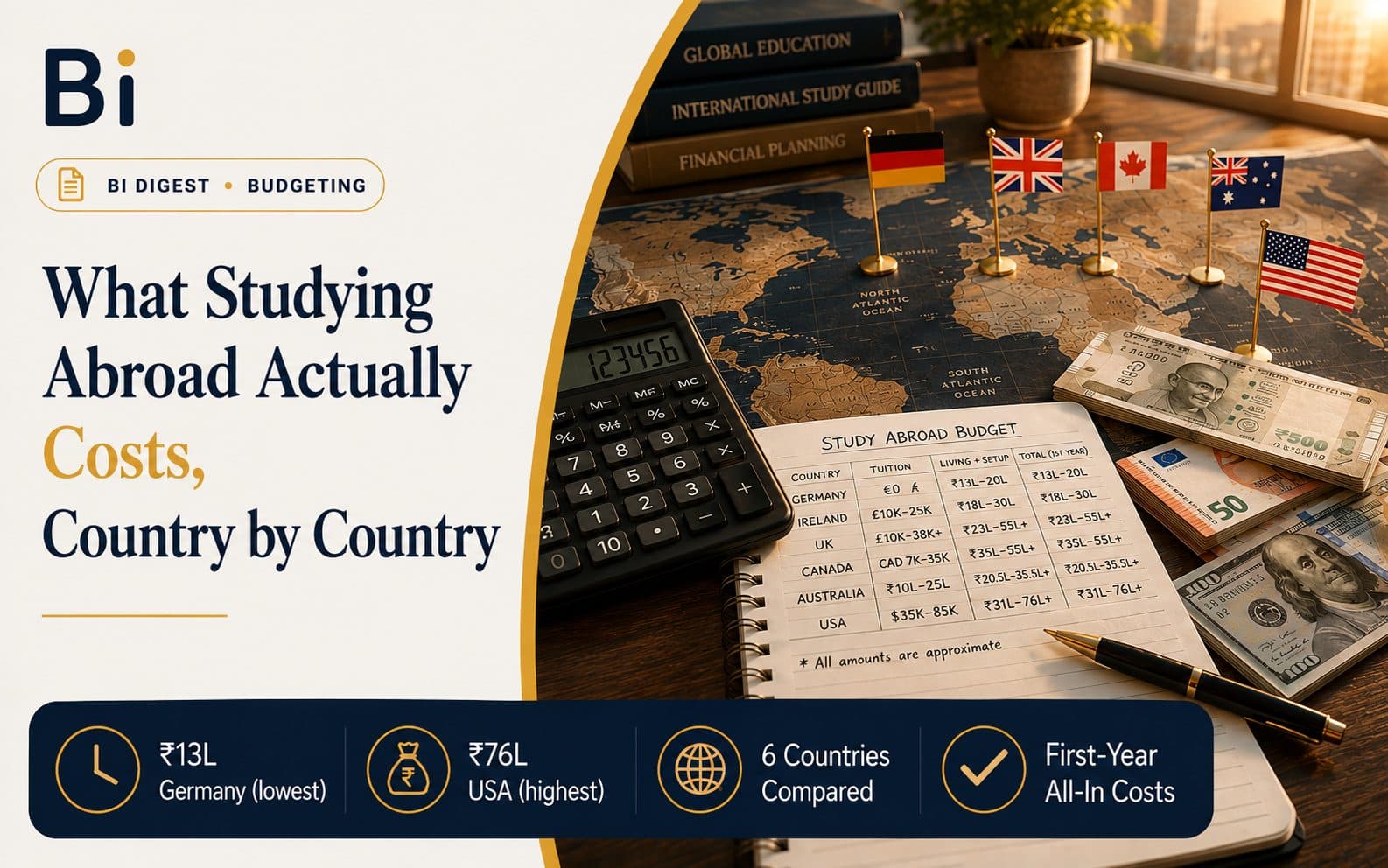
The gap between the cheapest and most expensive popular destinations is genuinely enormous: a first year in Germany can run as low as ₹13 lakh, while the same year in the US commonly runs ₹32–76 lakh — a five- to six-fold difference for what families often discuss as if it were one comparable decision.
By Mandeep Aulakh · Published 18 August 2026
The full comparison, first year, all-in
Every "cost of studying abroad" comparison suffers from the same problem: figures pulled from different years, different currencies, and different definitions of what's included. Here's the current, sourced picture, with what's actually inside each number.
| Country | Tuition (per year) | Total first-year cost (tuition + living + setup) |
|---|---|---|
| Germany | Largely €0 at public universities; semester fee €150–€400 | ₹13–20 lakh (mostly the blocked account and living costs, not tuition) |
| Ireland | €10,000–€25,000 | Roughly ₹18–30 lakh, tuition-dependent |
| UK | £10,000–£38,000+ | ₹23–55 lakh+ depending on tier and city |
| Canada | CAD 7,000–35,000 | ₹35–55 lakh, plus a mandatory GIC of CAD 22,895 for the visa (2025–26 figure) |
| Australia | ₹10–25 lakh | ₹20.5–35.5 lakh, plus visa fee (~AUD 620, ₹31,000) and mandatory OSHC health cover (₹22,500–30,000) |
| USA | $35,000–$85,000 total cost | ₹31–76 lakh, with top-tier MBA/Medicine programmes running considerably higher |
First-year study abroad costs by country, 2026
Why the range within each country is often bigger than the range between countries
The table above shows the middle of each country's range, but the honest picture is that within-country variation can dwarf country-to-country variation. In the US, a public state university runs roughly ₹18–35 lakh a year, while a top-tier MBA at an M7 school runs $80,000–115,000/year — nearly ₹1 crore, a gap larger than the entire difference between the UK and Australia. In Germany, the near-universal "public university, zero tuition" story sits alongside TUM's non-EU master's fees of €2,000–6,000 per semester — the same country, a genuinely different budget.
The practical implication: don't budget around a country's headline reputation ("Germany is cheap," "the US is expensive"). Budget around the specific university and programme tier within that country, since that's where most of the real variance actually sits.
What each figure does and doesn't include, because this is where most family budgets go wrong
Tuition is rarely the whole story. Every country layers additional mandatory costs on top: Germany's blocked account (€11,904/year, refundable but locked up front), Canada's GIC (CAD 22,895, similarly locked as visa-mandatory proof of funds), the UK's maintenance requirement (£13,761 for London), Australia's OSHC health cover — none of these are tuition, and all of them are non-negotiable parts of the actual budget your family needs to assemble, usually months before the first tuition instalment is even due.
First-year costs run higher than published averages almost everywhere. For the US, UK, Canada, and Australia specifically, actual first-year total costs commonly exceed the university-published "Cost of Attendance" figure by 25–35% once setup costs — flights, deposits, initial furnishing, the inevitable things nobody remembers to budget for — are included. Year two onward is meaningfully cheaper than year one for this reason, which is worth knowing before a family assumes costs stay flat across the whole programme.
Programme length changes the real total more than the annual figure suggests. A one-year UK or Irish masters and a two-year US or Canadian masters can have similar annual costs but very different total costs, simply because one runs half as long. When comparing countries, always convert to total programme cost, not annual cost — this is the single most common comparison error we see families make.
The honest way to use this comparison
Country-level cost comparisons are a genuinely useful starting filter — if Germany's ₹13–20 lakh and the US's ₹31–76 lakh both feel plausible for your family, you're comparing real options; if only one end of that range is realistic, that fact alone should narrow your shortlist before you fall in love with a specific university. But the comparison should be a first filter, not the final decision. A ₹20 lakh Germany plan that doesn't fit your child's field or German-language commitment is a worse outcome than a well-matched ₹45 lakh UK plan funded by a clean education loan. Cost sets the boundary of what's realistic; fit and post-study outcomes should decide what's chosen within it.
Frequently Asked Questions
Which country is cheapest to study abroad from India?
Germany, by a wide margin — a realistic first-year total at a public university outside Munich or Baden-Württemberg runs roughly ₹13–20 lakh, almost entirely living costs rather than tuition, since public tuition is close to zero.
Which country is most expensive to study abroad from India?
The USA, with total annual costs commonly ranging ₹31–76 lakh depending on university tier, and considerably higher for top-tier MBA or Medicine programmes, which can exceed ₹1 crore per year.
Do published tuition figures include everything I need to budget for?
No. Every major destination adds mandatory costs beyond tuition — blocked accounts, GICs, maintenance requirements, or health cover — that aren't tuition but are non-negotiable parts of your actual budget, often required months before your first tuition payment.
Is a country with lower annual costs always cheaper overall?
Not necessarily — programme length matters as much as the annual figure. A two-year programme with lower annual costs can total more than a one-year programme with higher annual costs. Always compare total programme cost, not just the yearly number.
Sources
TUM non-EU master's fees €2,000–6,000/semester
Studying-in-Germany.org, What Does It Cost to Study in Germany ↗UK tuition £10,000–£38,000+
Times Higher Education ↗Canada tuition CAD 7,000–35,000
Credila ↗Figures and rules change; always confirm against the official source for your application date.
Have a question this didn't answer?
Every situation is different. Talk to a counsellor for advice specific to your profile, budget, and timeline.