F-1 Visa Compliance: What Maintaining Status Actually Requires
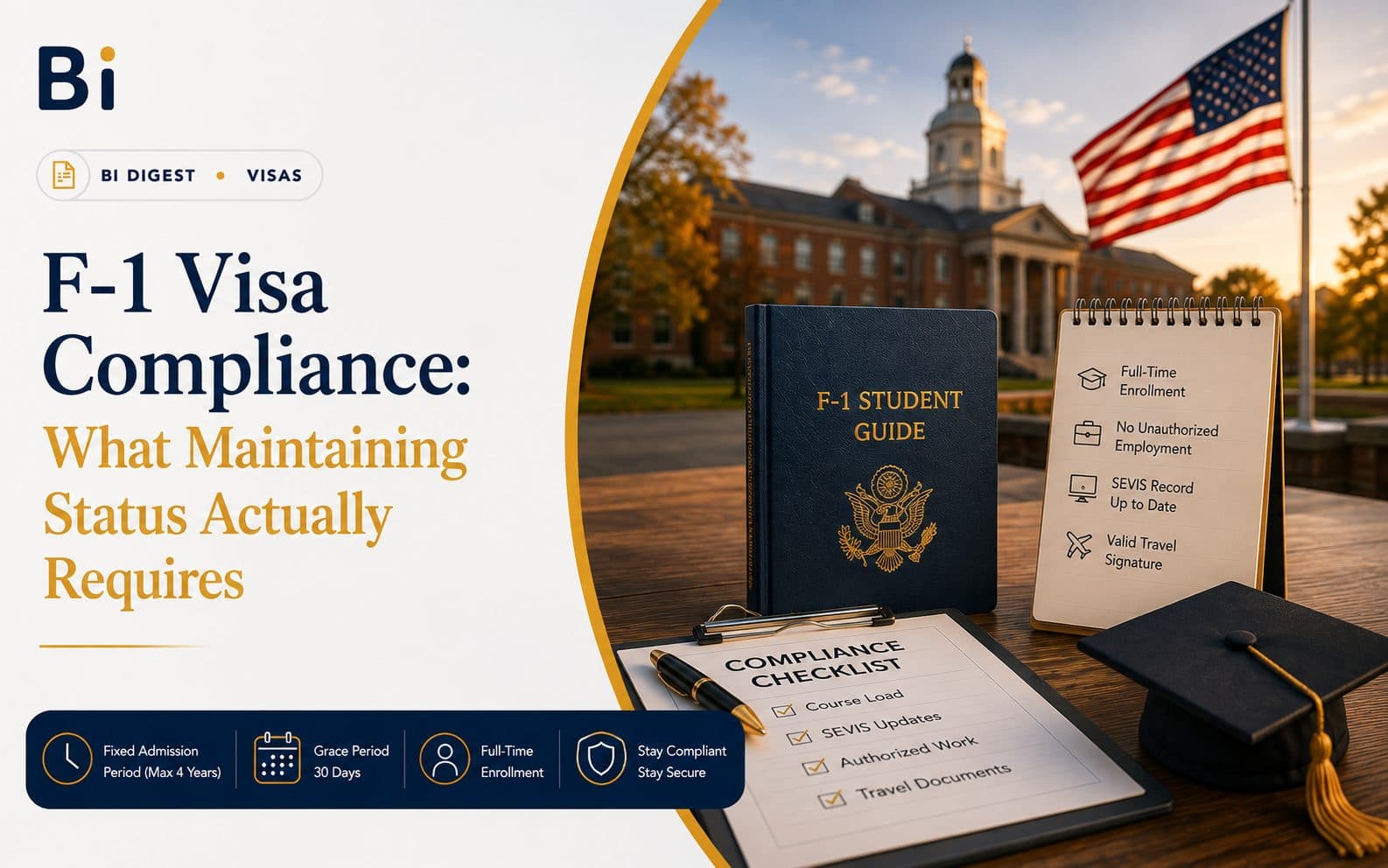
Maintaining F-1 status changed fundamentally on 15 September 2026: the old "duration of status" system, where you stayed valid as long as you were enrolled, no longer exists. You now hold a fixed admission period capped at 4 years, on top of the standing rules that haven't changed.
By Mandeep Aulakh · Published 17 August 2026
What's genuinely new: the fixed admission period
From 15 September 2026, F-1 students are admitted for a fixed period tied to their program length, capped at 4 years, rather than the old open-ended "duration of status". If your program will run longer than your fixed admission period — most relevant for PhD students, whose timelines routinely exceed four years — you must file a formal Extension of Stay (EOS) with USCIS before your period lapses, including a fee, biometrics, and evidence of sufficient funds. We've covered the full mechanics, transition rules, and who's actually affected in our dedicated piece on the policy change; this article focuses on what compliance means day-to-day going forward.
Two consequences worth internalising immediately: the post-completion grace period shrank from 60 days to 30, and F-1 graduate students generally can't change programs, majors, or transfer schools once a graduate program has begun, absent a qualifying exception. Both change how much room for error your compliance planning has.
What was already true, and still is
Full course load, every semester. This hasn't changed and remains the most basic compliance requirement: undergraduates typically need 12 credit hours, graduate students usually 9, with only specific, documented exceptions (academic difficulty, medical reasons, or a final semester needing fewer credits) permitted, and only with your Designated School Official's (DSO) prior approval. Dropping below full-time without that approval is one of the fastest ways to fall out of status, fixed admission period or not.
No unauthorised employment, ever. On-campus work is generally fine within limits (typically 20 hours/week during term). Off-campus work requires specific authorization — CPT, OPT, or severe economic hardship approval — obtained before you start working, not applied for retroactively. A single day of unauthorised work is a status violation, and it's one of the most common reasons students lose status without realising it happened until much later.
Keep your SEVIS record current. Address changes, program extensions, changes of major, or a reduced course load all need to be reported to your DSO and reflected in SEVIS promptly. Under the old duration-of-status system, a lapsed SEVIS record was already a real problem; under the new fixed-period system, it becomes a more urgent one, because your compliance record is now measured against a specific date rather than an open-ended standard.
Travel signatures matter more, not less, right now. Your DSO's signature on your I-20 needs to be current (generally within the last year, or 6 months if you're on OPT) before you travel internationally and try to re-enter. This has always been true, but during the transition period specifically, international travel carries an added consequence: students still on the old duration-of-status admission who travel and get readmitted will be placed onto the new fixed admission period upon re-entry, rather than keeping their D/S status. If you're currently on D/S and weighing a trip home, confirm with your DSO exactly what happens to your status on return before you book anything.
The compliance calendar, updated for the new system
| Milestone | What changed | What to do |
|---|---|---|
| Admission | Fixed period now, not indefinite D/S | Confirm your exact admission end date with your DSO — it's calculated from your program length, capped at 4 years |
| Program running long | New: requires formal filing | If your program will exceed your fixed period, file an EOS with USCIS before it lapses — acceptable grounds are compelling academic need, documented illness, or exceptional circumstances, not simply "still finishing" |
| Completing your program | Grace period halved | You now have 30 days to depart, transfer, or change status — not 60 |
| Wanting to change majors/schools (graduate level) | New restriction | Generally not permitted once your graduate program has begun, without an SEVP-approved exception |
| International travel | Transition-period nuance | If currently on D/S, confirm with your DSO what status you'll hold upon re-entry before booking travel |
Compliance milestones under the new fixed-period system
Why this matters more for some students than others
If you're on a standard one- or two-year masters, the fixed admission period is unlikely to ever become a live issue — you'll almost certainly finish well inside four years, and your main compliance obligations are the same ones that have always applied: course load, authorised work, SEVIS accuracy. The genuinely new administrative burden falls on PhD students, research scholars, and anyone on OPT/STEM OPT extensions that push a total stay close to or past four years — that population now needs EOS filing built into their timeline from day one, not treated as a late-stage formality.
For everyone, though, the shrunk grace period and the restriction on changing programs mean the cost of an unplanned setback — needing more time, wanting to pivot majors — is higher than it used to be. Compliance now rewards decisiveness about your program choice upfront and early communication with your DSO the moment anything about your timeline shifts, rather than sorting it out after the fact.
The honest bottom line
None of this makes the F-1 route a worse choice for a genuinely well-planned US degree — it adds paperwork and deadlines for a specific subset of students, mostly at the doctoral and research level, without touching admissions, teaching quality, or the underlying value of a US degree for the large majority of applicants on standard timelines. But "F-1 compliance" now means something structurally different than it did a year ago, and any advice, including anything you read elsewhere, that talks about duration of status as if it still exists is describing a system that stopped operating in September 2026.
Frequently Asked Questions
Does "duration of status" still exist for F-1 visas?
No. As of 15 September 2026, F-1 students are admitted for a fixed period tied to their program length, capped at 4 years, not the old open-ended duration of status. Anyone needing more time must file a formal Extension of Stay with USCIS.
How many credits do I need to maintain F-1 status?
Typically 12 credit hours for undergraduates and 9 for graduate students per semester, with only specific, DSO-approved exceptions (academic difficulty, medical reasons, or a final reduced-course semester).
What happens if my F-1 program runs longer than expected?
You must file an Extension of Stay with USCIS before your fixed admission period lapses. Acceptable grounds include compelling academic need, documented illness, or exceptional circumstances — not simply needing more time to finish coursework.
How long is the grace period after finishing an F-1 program now?
30 days, down from 60, for anyone completing their program or OPT/STEM OPT after the rule's effective date. Students currently on duration of status generally retain the 60-day grace period until they travel and are readmitted, or obtain an approved Extension of Stay.
Sources
Duration of status eliminated; fixed admission period capped at 4 years; effective 15 Sept 2026
DHS, official announcement ↗EOS filing requirement and grounds; fixed-period mechanics
Nixon Peabody LLP ↗EOS filing requirement and grounds; fixed-period mechanics
Ogletree Deakins ↗Grace period reduced to 30 days; transition rules for students on D/S
Yale OISS, Elimination of Duration of Status FAQ ↗Restrictions on changing programs/majors/schools at graduate level
Fragomen ↗Figures and rules change; always confirm against the official source for your application date.
Have a question this didn't answer?
Every situation is different. Talk to a counsellor for advice specific to your profile, budget, and timeline.