Post-Study Work Visas: How Long You Actually Get, by Country
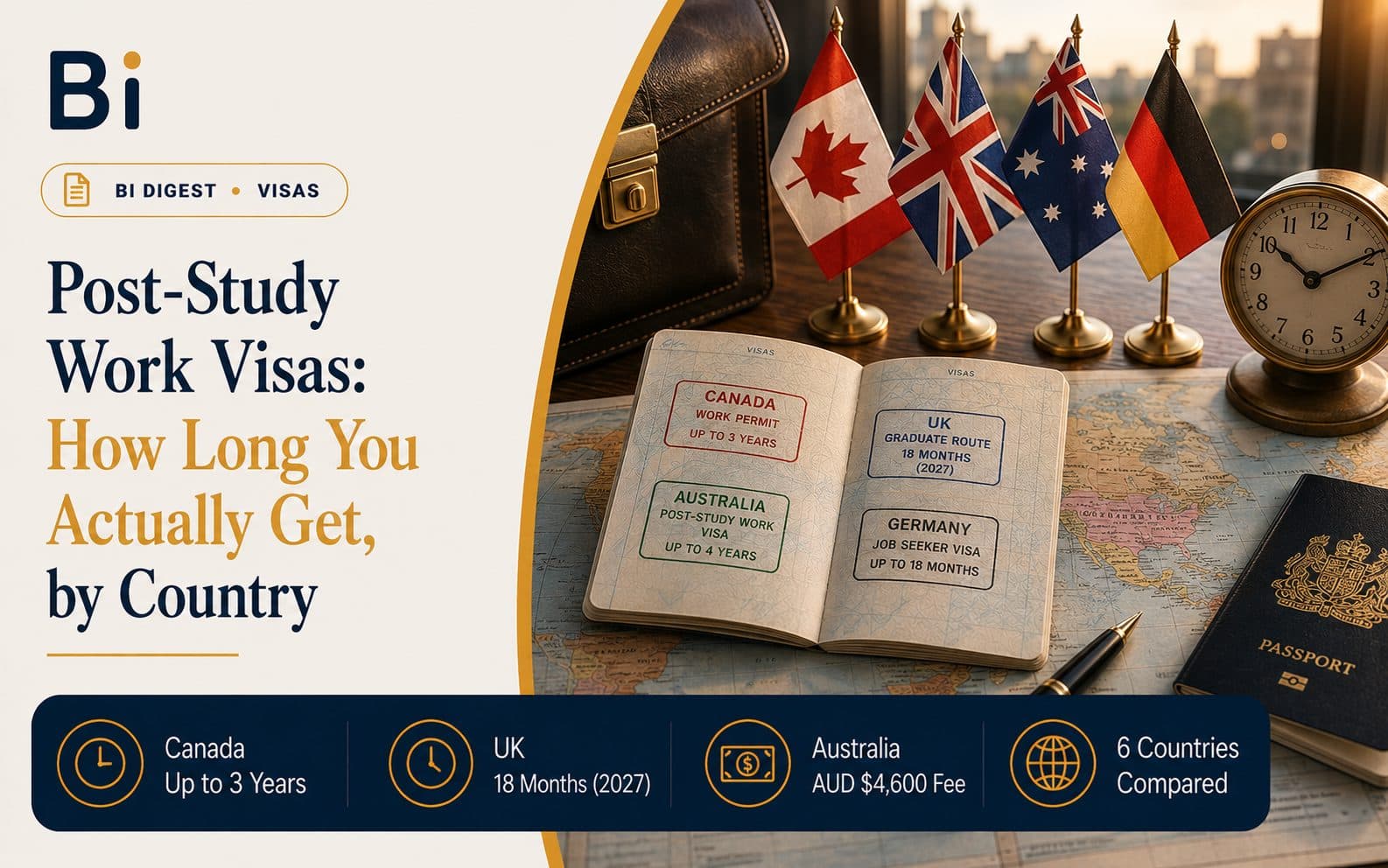
Canada's PGWP remains the longest standard post-study work visa at up to 3 years, but nearly every major destination changed its rules within the last year: Australia's post-study visa fee roughly doubled to AUD $4,600 from March 2026, the UK's window shrinks to 18 months for anyone starting from January 2027, and Canada itself now requires proof of English ahead of applying.
By Mandeep Aulakh · Published 18 August 2026
The current picture, country by country
The post-study work visa has become the single number students fixate on most, and for good reason — it's genuinely the bridge between a degree and a career abroad. But comparing raw months without the conditions attached to them is how students pick a destination for the wrong reasons. Here's what each major country actually offers right now, not the version that was true two years ago.
| Country | Visa | Duration | What changed recently |
|---|---|---|---|
| Canada | PGWP | Up to 3 years for most bachelor's, master's, and doctoral graduates | Proof of English/French (CLB 7, roughly IELTS 6.0) now required before applying; diploma/certificate programs restricted to a shortage-linked field list — degree-level programs are largely exempt |
| Australia | Subclass 485 | 2–4 years depending on qualification level | From 1 March 2026: application fee roughly doubled to AUD $4,600, the highest of any major destination; age limit tightened to 35 for most applicants (research masters/PhD keep a 50-year ceiling); minimum IELTS raised to 6.5, valid for only one year |
| UK | Graduate Route | 18 months for bachelor's/master's, since January 2027 is now the next available intake — the 2-year window only ever applied to courses starting by 31 December 2026 (PhD retains 3 years) | Confirmed reduction from the May 2025 Immigration White Paper |
| Ireland | Third Level Graduate Scheme (Stamp 1G) | 12 months at Level 8 (bachelor's); up to 24 months at Level 9+ (master's and above) | Registration fee €300; comparatively stable, no major 2026 restrictions |
| Germany | Job-seeker visa (§20 AufenthG) | 18 months | Work during the job-seeker period doesn't count toward EU Blue Card settlement time — only work under an actual Blue Card or work permit does |
| USA | OPT / STEM OPT | 12 months standard; up to 36 months total for STEM fields (12 + 24-month extension) | Beyond OPT, progression depends on winning the H-1B lottery, with a selection rate commonly cited around 18–25% |
Post-study work visas by country, 2026
What it actually costs, and how long processing takes
Duration gets all the attention, but cost and processing time are what actually determine when you can start working and how much you need saved before you apply. They vary far more than the visa lengths do — from Germany's under-€200 total to Australia's AUD $4,600, and from an 8-week UK decision to a 6-month Canadian wait if you apply from paper or outside the country.
| Country | Total fee | Typical processing time |
|---|---|---|
| Canada | CAD $255 government fee | 90–180 days for online applications filed from inside Canada; 4–7 months for paper or outside-Canada applications |
| Australia | AUD $4,600 (from 1 March 2026) | 50% of Post-Higher Education stream applications decided within 56 days; 90% within 4 months |
| UK | £937 application fee plus the Immigration Health Surcharge (£1,152.50 for 18 months, £2,070 for 2 years) | About 8 weeks from a complete online application |
| Ireland | €300 registration fee | Not published as a fixed standard; budget several weeks around your Stamp 1G registration appointment |
| Germany | Roughly €175 total (€75 visa fee plus €100 first-issuance processing fee) | 4 weeks to 3 months |
| USA | $470 online (I-765), or $1,780 for premium processing | 2–3 months for standard online filing; 30 business days with premium processing |
Post-study work visa cost and processing time, 2026
Why "longest visa" and "best pathway" aren't the same question
Raw duration is the number everyone compares first, and it's genuinely useful — but it hides two things that matter more for anyone actually planning a career, not just a gap year abroad.
Does the work count toward something. In Canada, essentially all PGWP-period work counts as Canadian experience feeding directly into Express Entry, the points-based permanent residency system. In the UK, by contrast, time on the Graduate Route does not count toward Indefinite Leave to Remain at all — you have to switch onto a Skilled Worker visa first, which carries its own salary threshold, currently around £38,700, that a meaningful share of graduate-level jobs don't clear. Germany's job-seeker period has the same disconnect: the 18 months buys you time to find a job, but the clock toward actual settlement only starts once you're on a Blue Card, not during the search itself.
Whether a job is required to get the visa at all. Canada, the UK, Ireland, and Germany's job-seeker visa all grant open work authorization with no job offer required — you graduate, apply, and search freely. The US is structurally different: OPT requires you to be actively employed or job-seeking within specific windows, and progression beyond it depends on an employer sponsoring you into the H-1B lottery, which is a genuinely different risk profile than the open-search model most other destinations offer.
What actually changed this year, destination by destination
Australia got noticeably more expensive and more restrictive. The fee increase to AUD $4,600 makes the Subclass 485 the most expensive post-study work visa among major destinations, and the tightened age ceiling and higher English bar both narrow who qualifies compared to even a year ago. Anyone budgeting a full Australia plan needs to price this in as a hard cost, not an afterthought at the end.
Canada added a language gate but kept the core offer stable. IRCC froze the list of PGWP-eligible programs for the full year in 2026, which is genuinely good news for planning after several years of frequent, disruptive changes — but the CLB 7 English/French requirement, in place since November 2024, means students now need to clear a real language bar before applying, not just meet it implicitly through having studied in English.
The UK's deadline has now effectively passed. The full 2-year Graduate Route only ever applied to courses starting by 31 December 2026 — since January 2027 is the next available intake, 18 months is the number that actually applies to anyone planning a UK application from here.
The honest way to use this comparison
Duration matters, but it's the third question, not the first. The first is whether you actually want to settle long-term or just gain a few years of international experience — Canada's PGWP-to-Express Entry pipeline is built for the former; the UK and US routes require a deliberate additional step (Skilled Worker sponsorship, H-1B) that isn't guaranteed. The second is whether your specific field has real hiring demand in that market — a generous visa window is worth little against a job market that isn't hiring your specialization. Only once those two are answered does raw visa length become the deciding factor between otherwise-comparable options.
Across the students we place every year, the pattern holds: the ones who chose their destination around the post-study pathway, not just the number, are consistently the ones who look back satisfied with the decision three years later — regardless of which country they picked.
Frequently Asked Questions
How much does a post-study work visa cost?
It varies enormously by country: roughly €175 total in Germany, CAD $255 (about ₹15,700) in Canada, €300 in Ireland, $470 for the US OPT application, £937 plus the Immigration Health Surcharge in the UK, and AUD $4,600 in Australia, by far the most expensive since its March 2026 fee increase.
How long does post-study work visa processing take?
The UK is fastest at around 8 weeks. Germany's job-seeker visa typically takes 4 weeks to 3 months, and the US OPT application 2–3 months standard (or 30 business days with premium processing). Canada's PGWP is the slowest of the major destinations for applications filed on paper or from outside Canada, at 4–7 months, though online applications filed from inside Canada usually clear in 90–180 days.
Which country has the longest post-study work visa?
Canada's PGWP offers up to 3 years for most bachelor's, master's, and doctoral graduates, generally the longest among major destinations. Australia's Subclass 485 can also reach 4 years for some qualification levels, but now carries a significantly higher cost and stricter age and English requirements as of 2026.
Does UK Graduate Route time count toward permanent settlement?
No — time on the Graduate Route does not count toward Indefinite Leave to Remain. You need to switch to a Skilled Worker visa, which requires employer sponsorship and clearing a salary threshold, before settlement time starts accumulating.
How much does Australia's post-study work visa cost now?
The Subclass 485 application fee roughly doubled to AUD $4,600 from 1 March 2026, making it the most expensive post-study work visa among major study destinations.
Do I need a job offer to get a post-study work visa?
Not in Canada, the UK, Ireland, or Germany's job-seeker visa — these grant open work authorization with no job required to apply. The US is different: OPT requires active employment or job-seeking, and staying beyond it depends on an employer sponsoring an H-1B application.
Sources
Canada PGWP up to 3 years; program-length-based duration rules
IRCC / Canada.ca, official PGWP page ↗UK Graduate Route: 18 months from Jan 2027, 3 years for PhD; GOV.UK visa fees and IHS
GOV.UK, Graduate visa ↗Germany job-seeker visa 18 months; doesn't count toward Blue Card settlement clock; Canada PGWP work counting toward Express Entry
Study-Abroad.org, Best Post-Grad Work Visas Guide ↗Australia Subclass 485 processing time by percentile (Post-Higher Education stream)
Department of Home Affairs, Global Visa Processing Times ↗USA OPT (Form I-765) filing fee and standard/premium processing time
USCIS, Form I-765 fee and processing information ↗Figures and rules change; always confirm against the official source for your application date.
Have a question this didn't answer?
Every situation is different. Talk to a counsellor for advice specific to your profile, budget, and timeline.