Study in the USA for Indian Students: Visa, Costs and OPT
US student rules changed twice this autumn: F-1 students now get a fixed stay instead of 'duration of status' (from 15 September 2026), and on 8 October the government proposed a US$70,000 fee that would sit behind every OPT work permit. Here is the visa route, what it costs and how work rights work, from the government sources.
By Mandeep Aulakh · Published 26 October 2026
The short answer: an F-1 visa, a fixed stay since 15 September 2026, and OPT for work afterwards
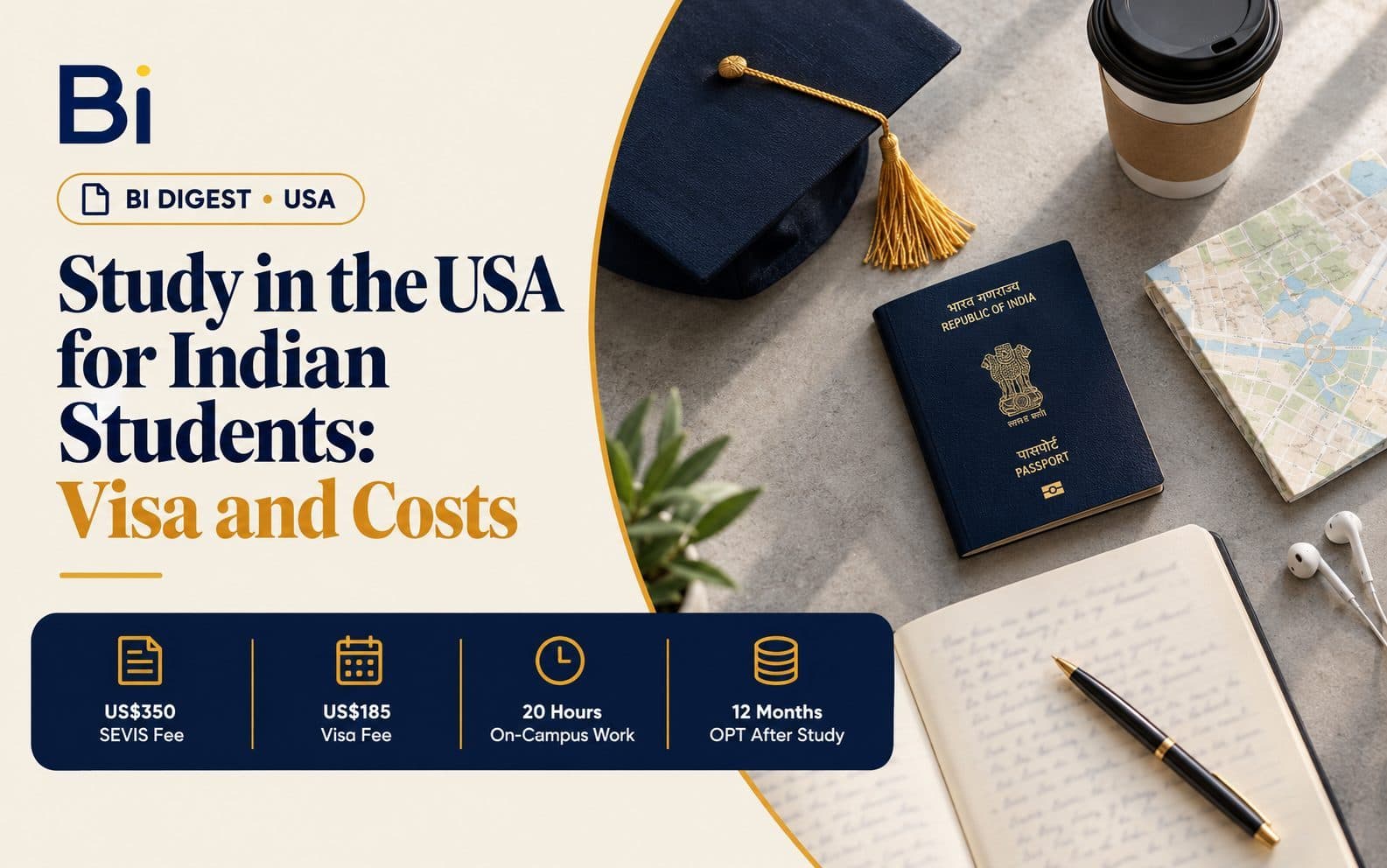
To study full time in the USA you need a place at a school certified by the Student and Exchange Visitor Program (SEVP), a Form I-20 from that school, and an F-1 student visa. You pay the US$350 I-901 SEVIS fee and the US$185 visa application fee, then attend a visa interview. While you study you may work up to 20 hours a week on campus, and afterwards Optional Practical Training (OPT) lets you work in your field for up to 12 months, with a 24-month extension for approved STEM degrees.
Two things changed recently and many older guides miss them. Since 15 September 2026, F-1 students are admitted for a fixed period tied to the I-20 instead of 'duration of status'. And on 8 October 2026 the Department of Homeland Security proposed a US$70,000 fee for each student's first OPT, to be paid by the school. That second item is a proposal, not a rule, and it is explained below.
| Item | What the source says | Notes |
|---|---|---|
| I-901 SEVIS fee | US$350 for F or M applicants | ICE fee table; paid before the visa interview |
| Visa application fee | US$185 | State Department fee notice (in force since June 2023) |
| Length of stay | Up to the program end date on your I-20, not more than 4 years, plus 30 days before and 30 days after | Rule effective 15 September 2026; replaces 'duration of status' |
| Work on campus | Up to 20 hours a week while school is in session; full time in breaks | ICE employment page |
| OPT after study | Up to 12 months; 24-month extension for STEM degrees on the DHS list | USCIS; a US$70,000 OPT fee has been proposed, not adopted |
| Indian students in the USA | 363,019 in 2024/25, up 10%; India is the top sending country | IIE Open Doors 2025 |
The USA at a glance for an F-1 student, from US government sources
The F-1 route, step by step
Step one is admission. Apply to schools that are SEVP-certified, and once you accept an offer the school issues your Form I-20. Step two is paying the I-901 SEVIS fee, which ICE lists at US$350 for F and M applicants. ICE's I-901 page directs payment through fmjfee.com by credit card, or by check, money order or Western Union, so use that site and avoid look-alike payment sites.
Step three is the visa itself. You complete the online DS-160 application, pay the US$185 visa application fee and attend an interview at a US embassy or consulate. The State Department said in June 2025 that all F, M and J applicants will be asked to set their social media profiles to public so that officers can review their online presence. Plan your timing: under the new rules you can enter the USA up to 30 days before the program start date on your I-20, but not earlier.
Visa headlines move fast and often get flattened. The pause on visa appointments in August 2026 applied to immigrant (green card) visas, not student visas, and our explainer on that is linked below. For anything that affects your own case, check the State Department's student visa page and your school's international office.
What changed on 15 September 2026: you now get a fixed stay
A DHS final rule published on 17 July 2026 took effect on 15 September 2026. F students used to be admitted for 'duration of status', meaning as long as they stayed enrolled. They are now admitted until the program end date on the I-20, up to a maximum of four years, plus 30 days to arrive and 30 days to leave. The departure period used to be 60 days.
If you need longer, for example a master's that runs over or a PhD that takes more than four years, you apply to USCIS for an extension of stay, after your designated school official (DSO) updates your I-20. Students who were already in the USA on 15 September 2026 can generally stay until the program end date on their I-20 or the end of their OPT, capped at four years, with a 60-day departure period.
The rule also limits switching. At graduate level and above, DHS says students cannot change their education level or their major at any point during the program, and cannot transfer at any point unless the Student and Exchange Visitor Program grants an exception for extenuating circumstances. For a student heading to a master's, that makes the choice of program more important than it used to be.
What it costs: sticker prices and what to check
There is no single US price. The College Board's Trends in College Pricing 2025 gives average published tuition and fees for full-time undergraduates in 2025-26: US$11,950 at public four-year colleges for in-state students, US$31,880 for out-of-state students, and US$45,000 at private nonprofit four-year colleges. These are averages for undergraduate programs, not for master's degrees, and individual schools can be far above or below them.
Your real number is on each school's own cost page and, once you are admitted, on your I-20. Tuition is only part of it: add accommodation, food, insurance and travel, and remember that the visa and SEVIS fees are paid up front.
| Type of college | Average per year | What it means |
|---|---|---|
| Public four-year, in-state | US$11,950 | Rate for state residents |
| Public four-year, out-of-state | US$31,880 | Rate for non-residents |
| Private nonprofit four-year | US$45,000 | Sticker price before any aid |
Average published undergraduate tuition and fees, 2025-26, College Board
Working while you study, and OPT afterwards
On campus, an F-1 student may work up to 20 hours a week while school is in session and full time during breaks, according to ICE. Off-campus work needs separate authorisation, for example curricular practical training (CPT) or OPT, arranged through your DSO.
OPT is the main route to US work experience after study. USCIS describes up to 12 months of OPT work authorisation tied to your field of study. If your degree is on the DHS STEM Designated Degree Program List, you can apply for a further 24-month extension. Under the September 2026 rule, students who file for post-completion OPT or STEM OPT on time do not need a separate extension of stay, and the 30-day departure period follows the end of the OPT period.
H-1B work visas, which some graduates move to after OPT, are a separate employer-sponsored process. Their fees and selection rules have changed repeatedly since 2025 and are being contested in court, so we have not covered them here. Check USCIS before you plan around them.
The proposed US$70,000 OPT fee: what is actually decided
On 8 October 2026 DHS published a proposed rule, not a final one, that would charge US$70,000 for a student's first OPT and US$30,000 for any later OPT. As written, the school would pay the fee, and it would have to be paid before the DSO records the OPT recommendation in the student's record. The proposal says DSOs are not required to recommend a student for OPT, and that a school can choose not to pay for a particular student.
Comments are open until 9 November 2026. If a final rule follows, DHS proposes it would take effect 60 days after publication and apply to OPT recommendations dated on or after that date. Nothing about OPT fees has been adopted yet, and the final text could differ. What this means for you today: ask each school how it would handle OPT if the fee were adopted, and do not assume either way.
How demand looks: Indian students and the recent dip
India is the largest source of international students in the USA: IIE's Open Doors 2025 report counts 363,019 Indian students in 2024/25, up 10% on the year before, ahead of China at 265,919. IIE's preliminary survey of more than 825 institutions for fall 2025 found total international enrollment down 1%, new international enrolments down 17%, and graduate enrolments down 12%, while OPT numbers rose 14%.
Those fall-2025 figures are a snapshot of reporting institutions, not the full count, but they explain why some schools are recruiting hard and why policy news matters when you choose a program.
The honest bottom line
The USA remains the largest destination for Indian students, and the route is clear: SEVP-certified school, I-20, SEVIS fee, visa interview, then fixed-period admission and OPT afterwards. What has changed is how much planning the system now asks of you: a fixed stay with an extension process, a shorter grace period, limits on switching programs at graduate level, and a proposed OPT fee that could change who pays for post-study work.
Do the numbers for the exact program you want, read the school's OPT policy, and check the sources below on the day you apply, because several of these rules are new or still moving.
Frequently Asked Questions
How much does it cost to apply for a US student visa from India?
The US government fees are US$350 for the I-901 SEVIS fee and US$185 for the visa application fee. Tuition, living costs and any school application fees are separate.
What does the end of 'duration of status' mean for F-1 students?
Since 15 September 2026 you are admitted until the program end date on your I-20, up to four years, plus 30 days before and after. If your program runs longer you file an extension of stay with USCIS through your school's designated school official.
How many hours can an F-1 student work on campus?
Up to 20 hours a week while school is in session and full time during breaks, according to ICE. Off-campus work needs authorisation such as CPT or OPT.
How long can I work in the USA after my degree on OPT?
USCIS describes up to 12 months of OPT. If your degree is on the DHS STEM Designated Degree Program List you can apply for a further 24-month extension.
Is the US$70,000 OPT fee law?
No. DHS proposed it on 8 October 2026 and comments close on 9 November 2026. As proposed, the school would pay US$70,000 for a first OPT and US$30,000 for later ones, and it would apply only after a final rule takes effect.
Can I change my major or transfer after I arrive?
At graduate level and above, DHS says no change of education level or major at any point, and no transfer unless SEVP grants an exception for extenuating circumstances. Below graduate level, changes of level or major and transfers are barred during the first year unless SEVP grants an exception.
Do I have to make my social media public for a US student visa?
The State Department said in June 2025 that F, M and J applicants will be asked to set their social media profiles to public. Check the State Department and US Embassy India pages for the current instruction before your interview.
Is the USA still popular with Indian students?
Yes. IIE counted 363,019 Indian students in the USA in 2024/25, up 10%, and India is the top sending country. A preliminary fall 2025 survey found new international enrolments down 17% overall.
Sources
Fixed period of admission, 4-year cap, 30-day arrival and departure periods, extension of stay, program-change limits, transition for current students
Study in the States (DHS) — Final Rule Quick Facts, fetched 2026-10-17 ↗Rule published 17 July 2026, effective 15 September 2026
Federal Register document 2026-14439 (metadata via the Federal Register API, fetched 2026-10-17) ↗Proposed OPT fees US$70,000 initial and US$30,000 subsequent, school pays, DSOs may decline, comments to 9 November 2026, 60-day effective date
Federal Register — Optional Practical Training Fees, proposed rule, 8 October 2026 (full text read from the govinfo PDF) ↗I-901 SEVIS fee US$350 for F or M applicants; payment through fmjfee.com or by check, money order or Western Union
ICE — I-901 SEVIS Fee, fetched 2026-10-17 ↗On-campus work up to 20 hours a week in session; off-campus work authorisation process
ICE — Employment, fetched 2026-10-17 ↗OPT up to 12 months; STEM OPT 24-month extension
USCIS — Optional Practical Training for F-1 Students, fetched 2026-10-17 ↗Visa application fee US$185 (since 17 June 2023)
U.S. Department of State — Nonimmigrant Visa Fee Increases, June 2023 ↗F, M and J applicants asked to set social media profiles to public
U.S. Department of State — Announcement of Expanded Screening and Vetting for Visa Applicants, June 2025 ↗363,019 Indian students in 2024/25 (+10%); fall 2025 snapshot: total -1%, new -17%, graduate -12%, OPT +14%
IIE Open Doors 2025 press release, fetched 2026-10-17 ↗Average published tuition and fees 2025-26: public in-state US$11,950, out-of-state US$31,880, private nonprofit US$45,000
College Board — Trends in College Pricing highlights, fetched 2026-10-17 ↗Figures and rules change; always confirm against the official source for your application date.
Have a question this didn't answer?
Every situation is different. Talk to a counsellor for advice specific to your profile, budget, and timeline.