US Visa Appointments Paused: What It Actually Means for Student Visas
Headlines calling this a blanket "US visa pause" are technically true and functionally misleading at the same time — the State Department did pause visa appointments worldwide on 26-27 August 2026, but only for immigrant visas (green card categories), not the F-1/M-1 student visas actually relevant to anyone planning to study in the US.
By Mandeep Aulakh · Published 27 August 2026
What actually got paused, and what didn't
On 26-27 August 2026, the US State Department paused immigrant visa interviews at every US embassy and consulate worldwide. If you've seen this reported as "US visa appointments paused," the headline is accurate but incomplete in a way that matters enormously if you're applying to study in the US.
The pause applies specifically to immigrant visas — the green card categories, covering family-based and employment-based applicants going through consular processing outside the US. It does not apply to nonimmigrant visas, which is the category F-1 (academic student) and M-1 (vocational student) visas fall under, alongside tourism, business, and temporary work visas. If you're applying to study in the US, this pause, as announced, does not touch your visa category.
Why the State Department paused immigrant visa interviews
The stated reason is training, not enforcement. Consular officers worldwide are being given mandatory instruction on the administration's expanded public charge screening requirements — the rules used to assess whether an immigrant visa applicant is likely to become dependent on US public benefits. The State Department's own framing is that this is about ensuring consistent evaluation across every consular post globally, not a security response to a specific incident.
Applicants with immigrant visa interviews already scheduled during the pause are receiving cancellation notices, with new appointment dates to be provided later. No end date has been confirmed; a State Department official has suggested it could run several weeks, varying by location, since each post needs to complete the training before resuming interviews.
Why this keeps getting confused with a student visa pause
This isn't the first time in 2026 that visa news out of Washington has gotten flattened into a single scary headline. In May 2025, the US did halt all new student and exchange visitor visa interviews globally for a period — a real, separate event that genuinely affected F-1/M-1 applicants at the time, while consular posts rolled out expanded social media vetting. That earlier pause is likely why this August 2026 immigrant-visa pause is getting misread as "the same thing happening again" — it isn't. The two events share a country and a headline shape, not a visa category.
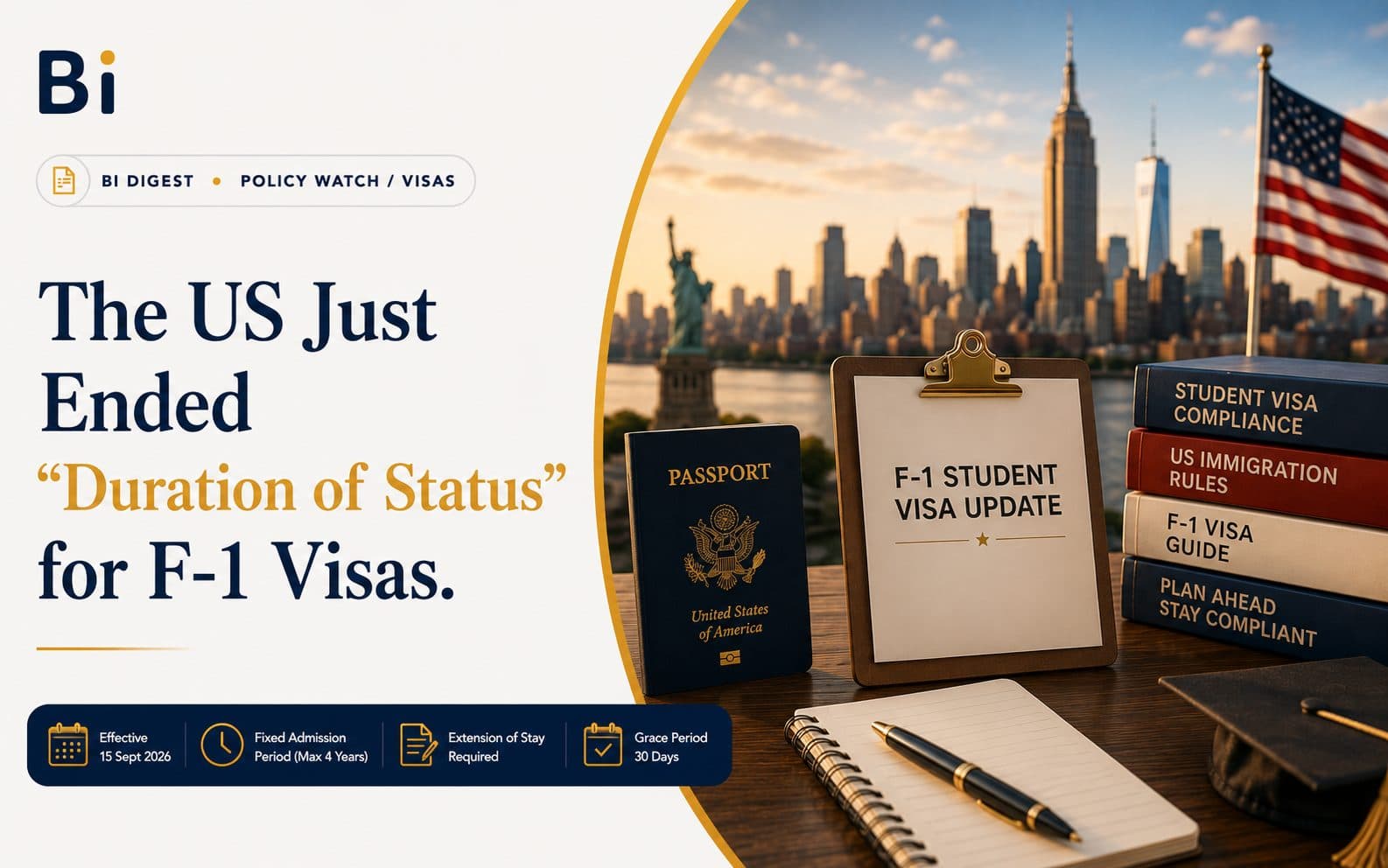
There's also a second, unrelated 2026 policy change getting mixed into the same conversation: the DHS final rule (effective 15 September 2026) that ends the old "duration of status" system for F-1 students, replacing indefinite status with a fixed admission period. That's a real, separate, ongoing change — covered in full in our dedicated breakdown — but it's a structural rule change to how long you're allowed to stay, not an appointment pause, and it isn't what's making headlines this week.
What to actually do if you have a US student visa application in progress
If your F-1 or M-1 interview is already scheduled, proceed exactly as planned — this pause has no bearing on your appointment category. If you haven't scheduled yet, book normally; nonimmigrant visa slots are opening and filling on the usual schedule, unaffected by the immigrant visa training pause running in parallel.
The one genuinely useful habit worth building from this: verify visa news against the primary source (travel.state.gov) or your consultant, rather than a headline alone, before it changes your plans. A scope word — "immigrant" versus "student," "paused" versus "delayed" — is often the entire difference between a real problem and a non-event, and headlines routinely drop it.
Frequently Asked Questions
Did the US pause student visa appointments in August 2026?
No. The pause announced 26-27 August 2026 applies only to immigrant visas (green card categories) — F-1 and M-1 student visas are nonimmigrant visas and are explicitly unaffected.
Why did the US pause immigrant visa appointments?
To train consular officers worldwide on newly expanded public charge screening requirements, aimed at ensuring immigrant visa applications are evaluated consistently across every US embassy and consulate.
How long will the immigrant visa pause last?
No official end date has been announced. A State Department official indicated it could take several weeks, varying by consular post, as each location completes the required training.
Is this the same as the 2025 student visa interview halt?
No — that was a separate, real event in May 2025 that did affect F-1/M-1 applicants directly. The August 2026 pause is a different policy action limited to immigrant visas.
Should I delay booking my F-1 visa interview because of this news?
No. Nonimmigrant visa appointments, including F-1 and M-1, are proceeding on their normal schedule and are not part of this pause.
Sources
Immigrant visa interviews paused worldwide 26-27 August 2026 for public charge screening training; no confirmed end date
The Washington Post ↗Pause applies to immigrant visas only; does not affect nonimmigrant visas including F-1/M-1 student visas
Fragomen, Del Rey, Bernsen & Loewy LLP ↗May 2025 global halt of new student and exchange visitor visa interviews, distinct prior event
News on Air (India) ↗Figures and rules change; always confirm against the official source for your application date.
Have a question this didn't answer?
Every situation is different. Talk to a counsellor for advice specific to your profile, budget, and timeline.