Study in Germany: Fees, APS, and the Job Market After
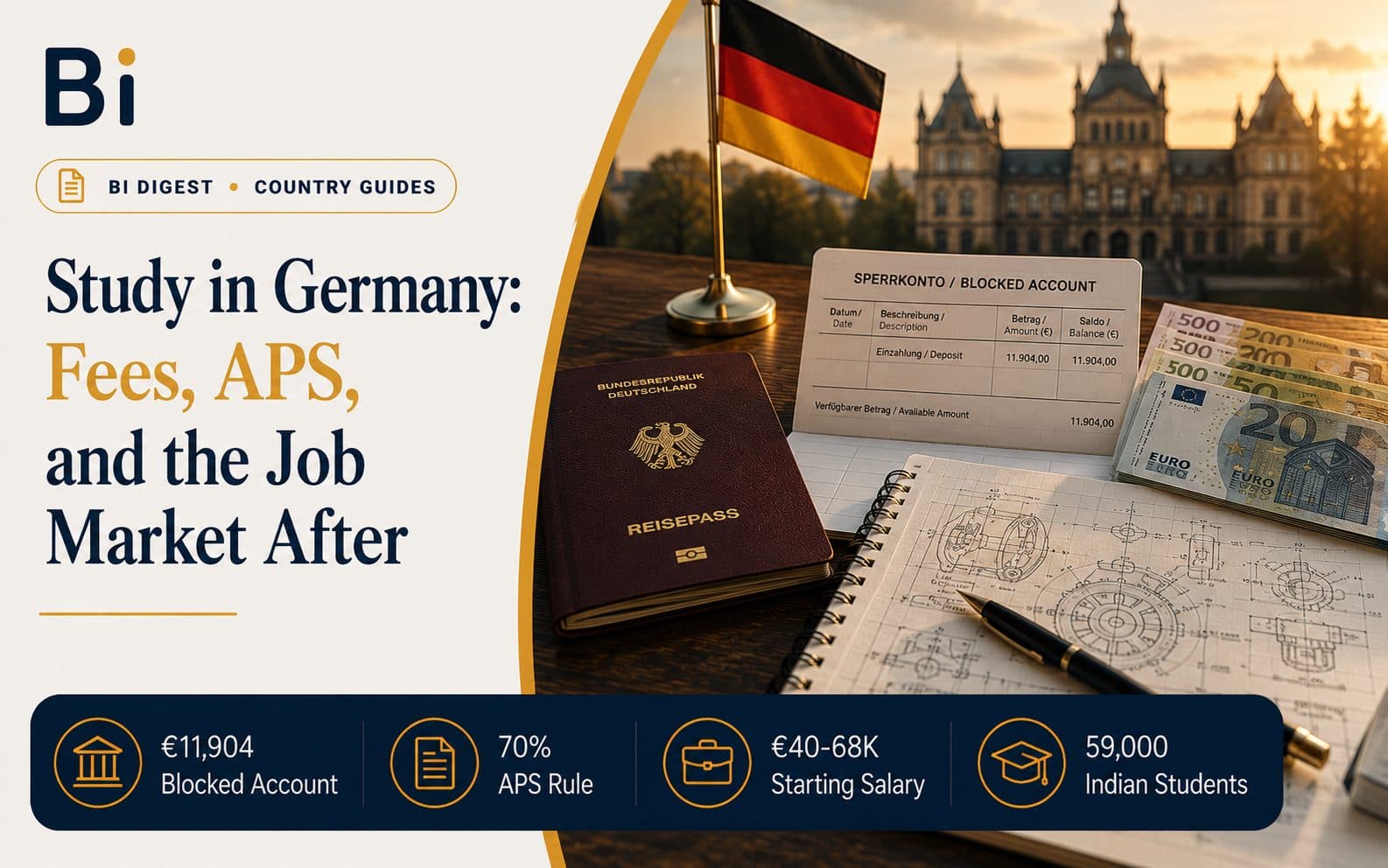
Public university tuition in Germany is genuinely close to zero for Indian students, but the real first-year cost still runs roughly ₹13–20 lakh once you account for the €11,904 blocked account, a semester fee, and living costs — and getting there now runs through a 70% Class 12 threshold and, for some master's fields, a brand-new aptitude test.
By Mandeep Aulakh · Published 18 August 2026
What tuition actually costs, by university type
The overwhelming majority of German public universities charge zero tuition for Bachelor's and consecutive Master's programmes, for Indian students exactly as for domestic ones. But "free" doesn't mean costless.
| University type | What you actually pay |
|---|---|
| Most public universities | €0 tuition; a semester contribution of €150–€400 covering admin and usually a public transport pass |
| Baden-Württemberg (Heidelberg, KIT, Freiburg, Tübingen) | €1,500/semester tuition for non-EU students — the main statewide exception |
| TUM (Technical University of Munich), most master's programmes | €2,000–€6,000/semester for non-EU students, varying by programme — a university-specific exception, not a Bavaria-wide rule |
| Private universities | Roughly €10,000–€20,000/year, sometimes higher for specialised programmes |
What you actually pay, by university type
The blocked account: the real cost most "free tuition" headlines bury
Before your visa is approved, you need to prove you can support yourself. The blocked account (Sperrkonto) requirement for 2026 is €11,904 for the year, released in monthly instalments of €992 — roughly ₹12.5–13.4 lakh depending on the day's exchange rate. This isn't a fee; it's your own money, held in a locked account and released to you monthly once you arrive, specifically designed so a student can't spend an entire year's budget in the first semester.
Setup with a blocked-account provider typically costs €49–€150, and the whole deposit is refunded if your visa is ultimately rejected. Put together — blocked account, semester fee, setup costs, and initial settling-in expenses — a realistic first-year budget at a zero-tuition public university outside Munich or Baden-Württemberg runs roughly ₹13–20 lakh, almost entirely living costs rather than tuition. For a TUM-track master's or a Baden-Württemberg university, budget meaningfully higher — ₹26–35 lakh in year one is realistic once the additional tuition is factored in.
Two 2026 eligibility gates that decide whether the "free tuition" plan even applies to you
This is the part where Germany content genuinely needs updating this year.
The APS certificate is mandatory before any application, and as of Winter Semester 2026/27, bachelor's applicants need at least 70% in Class 12 to qualify for direct university admission — a hard threshold that didn't exist before this year. Students below it are generally routed through Studienkolleg, a genuine one-year bridge programme, not a consolation path.
A new aptitude test, the dMAT, now applies to select master's fields. Announced in June 2026, it affects Indian applicants targeting Engineering, Business, Commerce, and Finance master's programmes from Summer Semester 2027 onward — an additional €150 test, separate from APS, not a replacement for it. If your target intake is Summer 2027 or later and your field is on the affected list, this needs building into your timeline now, not discovered mid-application.
What the job market after graduation actually looks like
Germany's pitch isn't just cheap tuition — it's a labour market genuinely short on the skills most Indian STEM graduates bring. Starting salaries after a German master's in Computer Science, Mechanical Engineering, Data Science, or Electrical Engineering commonly range €40,000–€68,000/year, against a total first-year study cost of roughly ₹13–20 lakh — a genuinely fast payback period compared to the total cost of a US or UK equivalent.
India has become Germany's single largest international student cohort, with roughly 59,000 enrolled in Winter Semester 2024/25 — up sharply year-on-year, which tells you something about how this trade-off is landing with Indian families in practice, not just in marketing copy.
Part-time work during study is capped at 140 full days or 280 half days per year, with a 2026 minimum wage of €13.90/hour — enough to meaningfully supplement the blocked-account income from Semester 2 onward, though not enough to fund a first year on its own.
After graduation, the job-seeker visa gives 18 months to find qualifying employment; once you find a role at or above the EU Blue Card salary threshold, that becomes one of the faster routes to EU permanent residency available anywhere — but worth remembering that time spent job-searching on the job-seeker visa itself doesn't count toward that settlement clock; only work under the Blue Card does.
The honest bottom line
The "study for free in Germany" pitch is directionally true and meaningfully undersold in most competitor content, once you separate tuition from total cost — but the real first-year number is closer to ₹13–20 lakh than zero, and getting there in 2026 now runs through eligibility gates (the 70% rule, and for some fields, the dMAT) that simply didn't exist a year ago. For a student with strong grades in a technical field and genuine willingness to build German-language ability, the maths remains excellent. For a student assuming "free" means the plan is automatically easy or automatically cheap, this article is the correction.
Frequently Asked Questions
How much does a Germany student visa cost and how long does it take?
The national (type D) student visa fee is €75, separate from the blocked account. Processing typically takes 4-8 weeks once you have an appointment, though it can stretch to 4-12 weeks depending on the consulate, and 3-6 months total once you count APS clearance and appointment waiting time. Applications submitted June-September, the peak season, often take 15-25% longer, so apply at least 3 months before your course starts.
Is studying in Germany actually free for Indian students?
Tuition is genuinely free or near-zero at most public universities — the main exceptions are Baden-Württemberg (€1,500/semester) and TUM's master's programmes (€2,000–€6,000/semester). But you still need a €11,904/year blocked account plus semester fees, so total first-year cost is roughly ₹13–20 lakh, not zero.
How much is Germany's blocked account requirement in 2026?
€11,904 for the year, released in monthly instalments of €992. It's your own money, refunded in full if your visa is rejected, not a fee paid to the government.
Do I need 70% in Class 12 to study in Germany?
Only for direct bachelor's admission, effective Winter Semester 2026/27. Students below that threshold are typically routed through Studienkolleg, a one-year bridge programme, rather than being disqualified outright.
What do German master's graduates typically earn?
Starting salaries in fields like Computer Science, Data Science, and Engineering commonly range €40,000–€68,000/year, against a total study cost of roughly ₹13–20 lakh at a zero-tuition public university — a fast payback period relative to comparable US or UK programmes.
Sources
One-year/two-semester Studienkolleg structure; TUM master's fees €2,000–6,000/semester
TUM, Preparatory Study at the Studienkolleg ↗70% Class 12 rule for APS-stage bachelor's eligibility, effective Winter 2026/27
MyGermanUniversity, APS India Guide ↗German national (type D) student visa fee €75; processing time 4-12 weeks, longer in peak season
Federal Foreign Office, National Visa for Study Purposes ↗Figures and rules change; always confirm against the official source for your application date.
Have a question this didn't answer?
Every situation is different. Talk to a counsellor for advice specific to your profile, budget, and timeline.