The APS Certificate: What It Is and Why Germany Requires It
Your visa approval odds are set long before you submit: by where you apply, when you start preparing your finances, and whether your file tells one consistent story. APS is the bottleneck nobody warns you about early enough — miss its timeline and your entire intake slips by a year.
By Mandeep Aulakh · Published 12 August 2026
Why Germany introduced APS, and why India specifically
APS exists because of a real, documented problem: German universities were receiving a rising volume of applications with academic credentials that were inconsistent, hard to verify, or occasionally fabricated, and checking each one individually, university by university, wasn't scalable. Centralising verification into a single certificate solved that. China was the first country required to go through APS, in 2001, followed by Vietnam in 2007. India followed considerably later: APS became mandatory for Indian applicants in November 2022, run jointly by the German Embassy in New Delhi and DAAD, Germany's academic exchange service.
What APS actually verifies, and who needs it
APS, short for Akademische Prüfstelle, checks that your academic record, from Class 10 through your highest qualification, is genuine and meets the standard German institutions expect. It applies to Indian students applying for a bachelor's, master's, or PhD in Germany, and to Studienkolleg applicants. It doesn't apply if you hold a German or EU passport, if you're on a DAAD or Erasmus+ scholarship, if your highest qualification came from outside India (an IB diploma, A-Levels, or a foreign bachelor's), or for short programmes under 90 days.
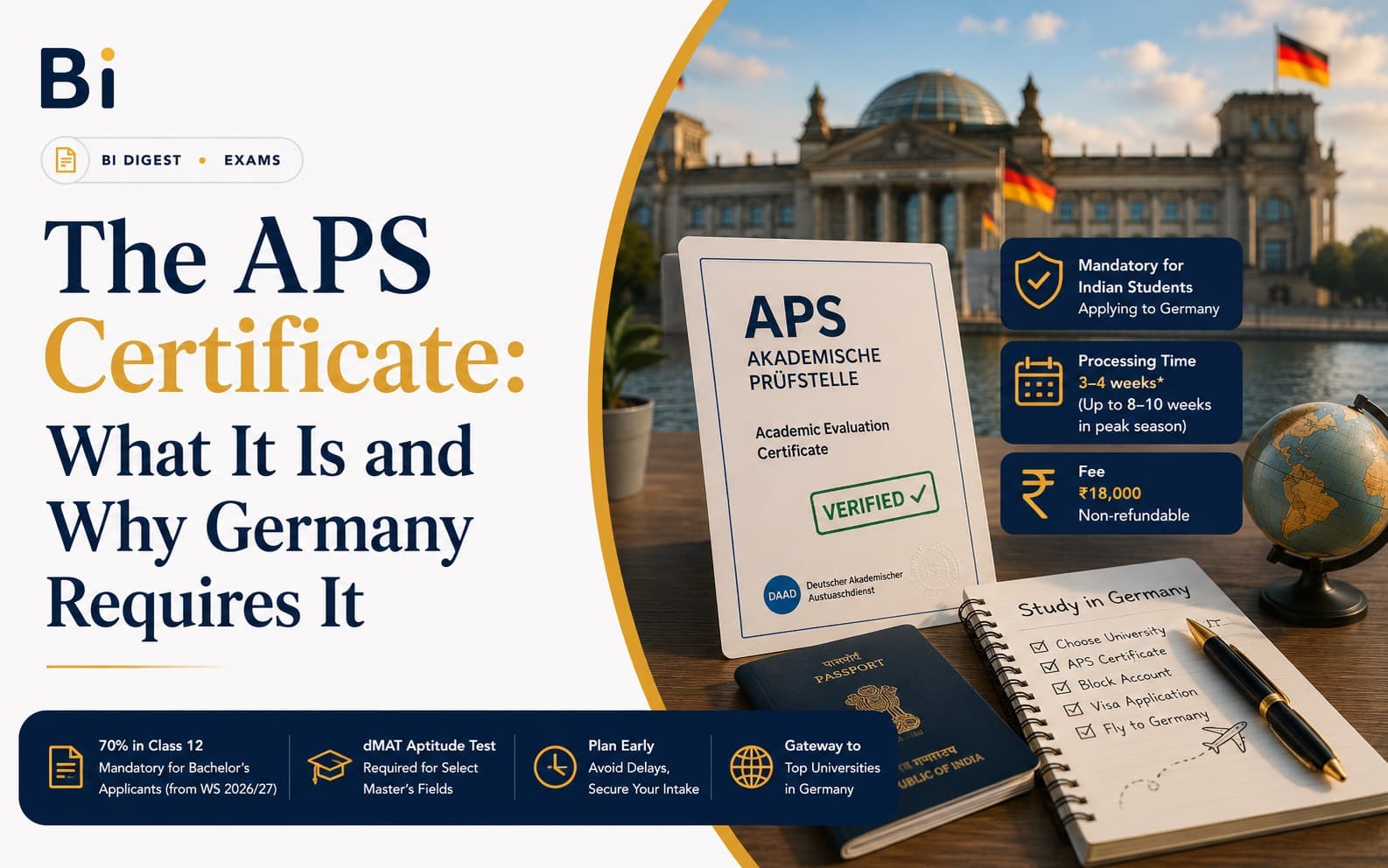
What's genuinely new since this article was last written: effective from Winter Semester 2026/27, all Indian bachelor's applicants must have scored at least 70% in Class 12, regardless of board — CBSE, ICSE, or state board. This didn't exist when APS launched in 2022, and it's a hard eligibility line, not a guideline: students below the threshold now route through the Studienkolleg pathway instead of direct bachelor's admission. Worth being precise here since it's a common point of confusion: this 70% threshold applies at the APS stage specifically for bachelor's applicants — there's no equivalent APS-level percentage cutoff for master's applicants, though individual universities set their own CGPA requirements (typically 60-75%, or roughly 6.5/10 CGPA) at the admissions stage separately.
This isn't a small population of applicants affected by the process overall: APS India processed more than 57,000 applications in just the first 16 months after the mandate was introduced, which is the real reason a three-week estimate turning into a three-month wait during peak months isn't a rare edge case — it's a predictable capacity problem at scale.
The dMAT: a brand-new test, separate from APS itself
If you're a master's applicant rather than a bachelor's one, there's a second, entirely new requirement to know about, and it's recent enough that almost nothing published before mid-2026 mentions it. APS India, working with g.a.s.t. (the body behind TestAS and TestDaF), announced the Digital Master Test — dMAT — on 29 June 2026. It's a standardised aptitude test, and it applies to Indian graduates applying for a master's in Germany from Summer Semester 2027 onward, in a defined list of fields — Engineering, Business, Commerce, Finance, and related quantitative disciplines are the ones most consistently named.
A few things worth being precise about, because there's real confusion circulating online: the dMAT doesn't replace APS. It's an additional document you submit alongside your existing APS paperwork, not a substitute for it — APS India continues verifying your academic records exactly as before. It also isn't a subject exam: it's a computer-based assessment of logical reasoning, data interpretation, and analytical problem-solving, not your engineering formulas or textbook knowledge, scored on a 0-200 scale. And a low score doesn't trigger an automatic APS refusal or university rejection — it's one input among several, not a hard gate the way the Class 12 percentage rule is for bachelor's applicants.
On timing: registration opened 29 June 2026 and closes 15 September 2026, with the first Indian sitting on 26 September 2026 and results out 12 October 2026. The fee is €150 (roughly ₹16,300), paid separately to g.a.s.t., not to APS India. Critically, if you're applying for Winter Semester 2026/27, you are not affected — the first dMAT certificates won't exist until October 2026, after that intake's deadlines. It's a Summer 2027-onward requirement. If your target intake is Summer 2027 or later and your field is on the affected list, register for dMAT early and plan it alongside, not instead of, your APS timeline — it adds a step, not a delay, if you sequence it correctly. One more clarification worth having on record: since there's no minimum passing score for dMAT and your certificate carries no expiry once issued, there's no practical reason to retake it purely to try to improve an APS outcome — retakes exist as an option, at €150 each, but they're for your own confidence in the score you present, not a requirement APS is checking against a threshold.
Cost, timeline, and what actually causes delays
The fee is ₹18,000, paid via CCAvenue, UPI, or bank transfer, and it is non-refundable regardless of outcome — including if your application is rejected. Additional certified copies run separately if you need more than the standard set.
On timeline, be sceptical of any guide quoting a single confident number. Processing normally takes 3-4 weeks after your complete document set and payment are received, but that assumes off-peak submission, and estimates for peak season genuinely vary across sources — anywhere from 6-12 weeks to 8-10 weeks to, in the worst cases, up to 3 months. That spread isn't guesswork: APS India officially states it cannot guarantee a specific processing timeframe, which is precisely why every experienced counsellor tells students to plan against the worst case, not the best one. The practical rule we give students: apply at least 4-5 months before your actual visa appointment date, not just before the university deadline. If you're targeting a Winter Semester 2026 start, the Uni-Assist submission deadline is 15 July 2026 — working back 4-5 months from your visa slot puts your APS application in February or March, not June.
One detail specific to final-year bachelor's students that we see missed constantly: if you're graduating in May or June and need your APS certificate for a July visa application, don't wait for your final degree certificate. APS accepts a provisional certificate carrying your university's official seal and a registrar's letter, so start the process in February on that basis rather than losing months waiting for the final parchment.
You'll need your Class 10 and 12 mark sheets, degree certificates, academic transcripts, English test scores, a passport copy, and your university admission letter (where applicable). One detail that trips people up: APS wants A4 colour photocopies, not originals — originals aren't returned if you send them. The single biggest cause of delay beyond document assembly itself is institutional response time: APS emails your school or university to verify records directly, and a slow-responding registrar or HOD is consistently cited as the most common bottleneck — worth flagging to your institution the moment you register, not after you've submitted.
Most applicants also attend a short interview as part of the process — a 20-40 minute academic discussion, not an additional cost. What we tell students preparing for it: it isn't testing your English or your nerves, it's testing whether you can speak about your own degree with genuine fluency. Students who stumble here are rarely the ones with messy paperwork; they're the ones who can't discuss their own coursework confidently. If you are rejected, you receive a written reason and can reapply after three months — so a rejection isn't fatal, but it does cost an intake cycle if it happens close to a deadline.
One genuinely good piece of news buried in the process: once issued, your APS certificate is valid for life. Get it done early, in your first year of planning, and it's simply available whenever you need it for any future German application, not something you redo per intake.
Sequence it first, not alongside everything else
Because APS certification happens before most German university applications are even submitted, not alongside them, it belongs at the very start of your Germany plan, not something you sort out once you already have an offer. Students who treat it as a late-stage formality are consistently the ones who miss an intake entirely, not because their academic profile was weak, but because a three-to-four-week process quietly became a three-month one at the exact moment they had no slack left. Start APS the moment you've decided Germany is a real option, well before you've shortlisted specific universities. It's covered in more depth, alongside the rest of the Germany timeline, in our Germany country guide; and if you're still weighing Germany against other destinations, see our Ireland vs Germany vs UK comparison.
Frequently Asked Questions
Is APS certification required for every Indian student applying to Germany?
It applies to bachelor's, master's, and PhD applicants, and Studienkolleg applicants, if your qualifications from Class 10 onward were completed in India. It doesn't apply to German or EU passport holders, students on a DAAD or Erasmus+ scholarship, applicants whose highest qualification is from outside India, or short programmes under 90 days.
How long before I apply to universities should I start the APS process?
As early as possible, ideally as your very first step once Germany becomes a real option. Processing takes 3-4 weeks off-peak but APS India itself doesn't guarantee a timeframe, and peak-season estimates range from 6 weeks to 3 months depending on volume. Plan for at least 4-5 months before your visa appointment. Final-year students can start on a provisional certificate rather than waiting for their final degree parchment.
What is the new 70% rule for APS in 2026?
Effective Winter Semester 2026/27, Indian bachelor's applicants need at least 70% in Class 12, regardless of board, to qualify for direct bachelor's admission. Students below that threshold typically route through the Studienkolleg pathway instead.
Does the 70% Class 12 rule apply to master's applicants too?
No — the 70% threshold at the APS stage applies specifically to bachelor's applicants. There's no equivalent APS-level percentage cutoff for master's applicants, though individual universities set their own CGPA requirements separately at admissions, typically 60-75% or around 6.5/10 CGPA.
What is the dMAT and do I need to take it?
The dMAT (Digital Master Test) is a new aptitude test for Indian master's applicants in select fields (Engineering, Business, Commerce, Finance), required for Summer Semester 2027 intakes and later. It's separate from APS — an additional document, not a replacement — costs €150, and doesn't apply if you're targeting Winter 2026/27 or earlier.
What happens if my APS application is rejected?
You receive a written reason for the rejection and can reapply after three months. The ₹18,000 fee is non-refundable, so a rejection close to your intake deadline can cost you an entire application cycle.
Sources
Processing 3-4 weeks normal; peak-season range 6-12 weeks; APS doesn't guarantee a timeframe
MyGermanUniversity, APS India Guide ↗Figures and rules change; always confirm against the official source for your application date.
Have a question this didn't answer?
Every situation is different. Talk to a counsellor for advice specific to your profile, budget, and timeline.