Studienkolleg: The Bridge Year Most Indian Applicants Don't Expect to Need
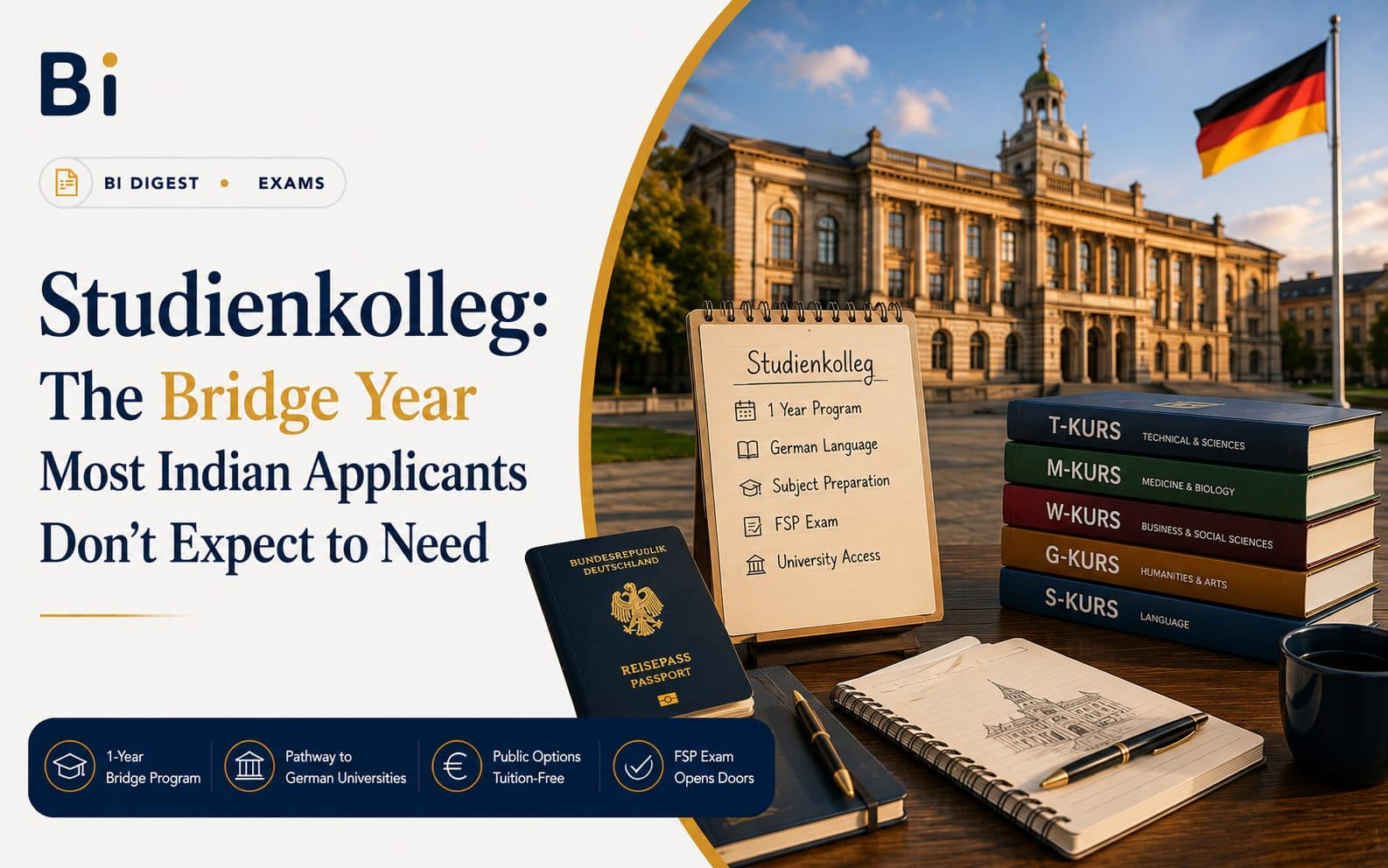
Studienkolleg is a one-year bridge program required for most Indian students heading straight to a German bachelor's, because Germany's 13-year schooling system doesn't automatically recognise a 12-year Indian Class 12 as equivalent to the Abitur. Since Winter Semester 2026/27, it's also the default route for any bachelor's applicant who doesn't clear APS's new 70% Class 12 threshold.
By Mandeep Aulakh · Published 18 August 2026
Why it exists at all
Germany's schooling system runs 13 years, ending in the Abitur, the country's standard university entrance qualification. India's runs 12. That one-year structural gap is the entire reason Studienkolleg exists: if your school-leaving certificate isn't considered equivalent to the Abitur — which is the default position for a straight Indian Class 12 certificate — you'll generally need to complete a Studienkolleg before you can enrol directly in a bachelor's programme. Whether you specifically need it is determined during APS evaluation, cross-checked against Anabin (the German database of foreign qualification equivalencies) or your target university's own assessment.
What it actually involves
Studienkolleg is a one-year preparatory programme, structured as two semesters, combining German language instruction, subject-specific coursework aligned to your intended degree, and orientation to how German university study actually works. At the end, you sit the Feststellungsprüfung (FSP) — a final exam that, if passed, grants you subject-specific entrance qualification to apply for a matching bachelor's programme.
The course you're assigned to depends on your intended field, and from Winter Semester 2025/26, most Studienkollegs now only let you apply for a single course track, so choose carefully before applying — switching later isn't a given.
| Course | Field |
|---|---|
| T-Kurs | Technical, mathematical, and natural science degrees |
| M-Kurs | Medicine and biology degrees |
| W-Kurs | Business and social science degrees |
| G-Kurs | Humanities and arts degrees |
| S-Kurs | Language-focused degrees |
Studienkolleg course tracks
Cost: the gap between public and private is large, and worth planning around
Public Studienkollegs, usually attached to a university, are largely tuition-free — you typically just pay a small semester/student-union fee, making them one of the cheapest routes into German higher education anywhere. But places at public Studienkollegs are limited and classes are taught only in German, which raises the real prerequisite most guides underplay: you need working German before you start, not just by the time you finish.
Private Studienkollegs charge considerably more — commonly cited figures range from around €8,000 up to roughly €12,000 for the full programme — but typically offer smaller classes, broader student services, some English-medium instruction, and in some cases a guaranteed progression pathway to a partner university. For a student who can't yet clear the German-language bar public options require, or who wants more certainty in an already uncertain first year abroad, the private route buys real things — it isn't purely a premium for convenience.
The language requirement people underestimate
Most Studienkolleg programmes require at least B1–B2 level German to start, and the Feststellungsprüfung itself is typically conducted in German regardless of which track you're on. If Germany is even a probable option, start German at least 12 months before you'd apply — Goethe-Institut centres and private institutes in India both run structured A1–B2 pathways, and starting late is one of the most common reasons students end up needing an extra semester before Studienkolleg even begins.
What's genuinely new: the 70% rule now decides who gets routed here
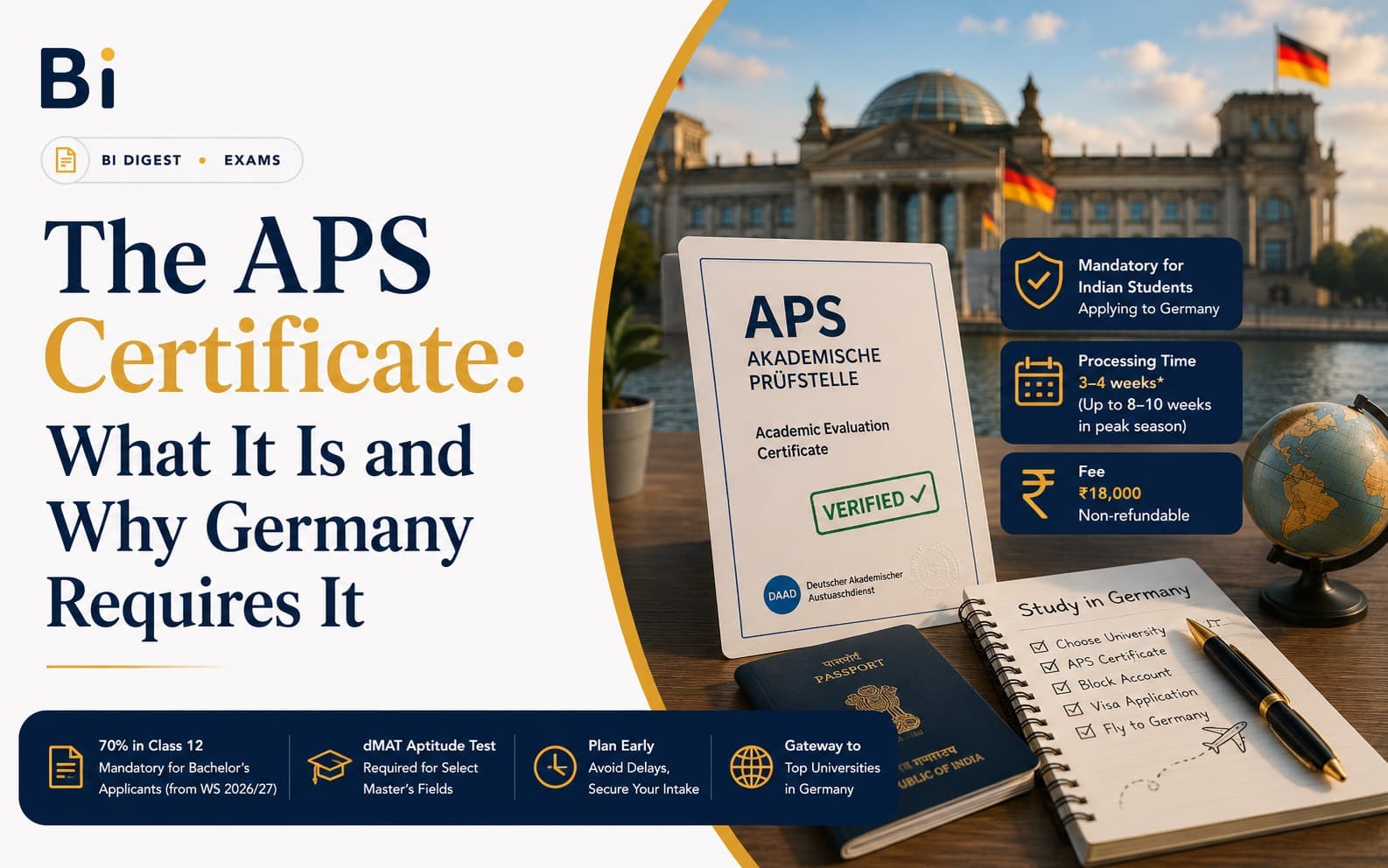
This is the update that didn't exist when older versions of this guide were written. Effective from Winter Semester 2026/27, Indian bachelor's applicants need at least 70% in Class 12 to qualify for direct university admission at the APS stage, regardless of board — we've covered the rule in full in our APS certificate guide. The direct consequence for Studienkolleg: applicants below that 70% line are now the default Studienkolleg population, not just students whose specific subject combination or state board historically fell short of Abitur-equivalence.
This changes who should be planning around Studienkolleg from the start. Previously, whether you needed it was mostly a question of subject alignment and board recognition. Now it's also a flat percentage gate, which means a strong student in the 60–69% range, who might previously have had a case for direct entry depending on their board and subjects, is now much more likely to be routed to Studienkolleg by default — worth knowing early enough to plan the extra year into your timeline and budget deliberately, rather than discovering it mid-application.
There are still limited direct-entry paths that bypass Studienkolleg even below the usual thresholds. Completing one year at a recognised Indian university with good grades, holding a strong JEE Main/Advanced rank, or specific 12th-grade subject combinations with 70%+ in relevant subjects can open direct admission in particular cases — but these are university-specific exceptions, not guarantees, and need checking against your specific target institution rather than assumed generally.
If you fail the Feststellungsprüfung
It isn't a one-shot exam with no recourse. Students who fail the midterm assessments can generally retake them once; failing means the Studienkolleg typically extends by a semester (three semesters total) rather than ending the pathway outright. Failing twice generally ends the ability to continue the programme — which is the scenario worth actively planning against, particularly by not under-preparing German before you even start.
The honest planning takeaway
Studienkolleg isn't a defeat or a downgrade — passing the FSP from a public Studienkolleg is widely and directly accepted across German universities, and a meaningful share of successful Germany placements go through exactly this route. But it is a real extra year, with a real language prerequisite, and — as of this year — a much more predictable trigger via the 70% APS rule than it used to have. The students who plan for it calmly, starting German early and budgeting the extra year in from the outset, do fine. The students who discover it only after an APS evaluation comes back are the ones who lose a full intake cycle scrambling.
Frequently Asked Questions
Does every Indian student need Studienkolleg to study in Germany?
No — it depends on your board, subjects, and (since Winter 2026/27) your Class 12 percentage. Students clearing 70%+ with the right subject alignment can often go direct; students below that threshold are now the default Studienkolleg population, alongside anyone whose qualification Anabin or APS deems non-equivalent regardless of percentage.
How long does Studienkolleg take?
One year, structured as two semesters, ending in the Feststellungsprüfung (FSP) exam. If you fail and retake once, it can extend to three semesters.
Is Studienkolleg free?
Public Studienkollegs are largely tuition-free, with only a small semester fee — but places are limited and taught only in German. Private options cost roughly €8,000–€12,000 but offer smaller classes and sometimes English-medium instruction.
What German level do I need for Studienkolleg?
Most programmes require B1–B2 level German to start, and the final FSP exam is typically conducted in German. Start learning at least 12 months before you'd apply.
Sources
Germany's 13-year system vs India's 12-year system; Abitur equivalence gap
Expatrio, Studienkolleg Guide ↗One-year/two-semester structure; FSP exam; course tracks (T/M/W); single-course-choice rule from Winter 2025/26
TUM, Preparatory Study at the Studienkolleg ↗G-Kurs, S-Kurs tracks; retake/extension rules; private Studienkolleg cost (~€12,000)
Berlin International College, Studienkolleg Guide 2026 ↗Public tuition-free status; private fees up to ~€8,000; B2 language requirement
Studying-in-Germany.org, Studienkolleg ↗New 70% Class 12 rule for bachelor's applicants, effective Winter 2026/27
MyGermanUniversity, APS India Guide ↗Figures and rules change; always confirm against the official source for your application date.
Have a question this didn't answer?
Every situation is different. Talk to a counsellor for advice specific to your profile, budget, and timeline.