Study in Canada for Indian Students: The Complete 2026 Guide
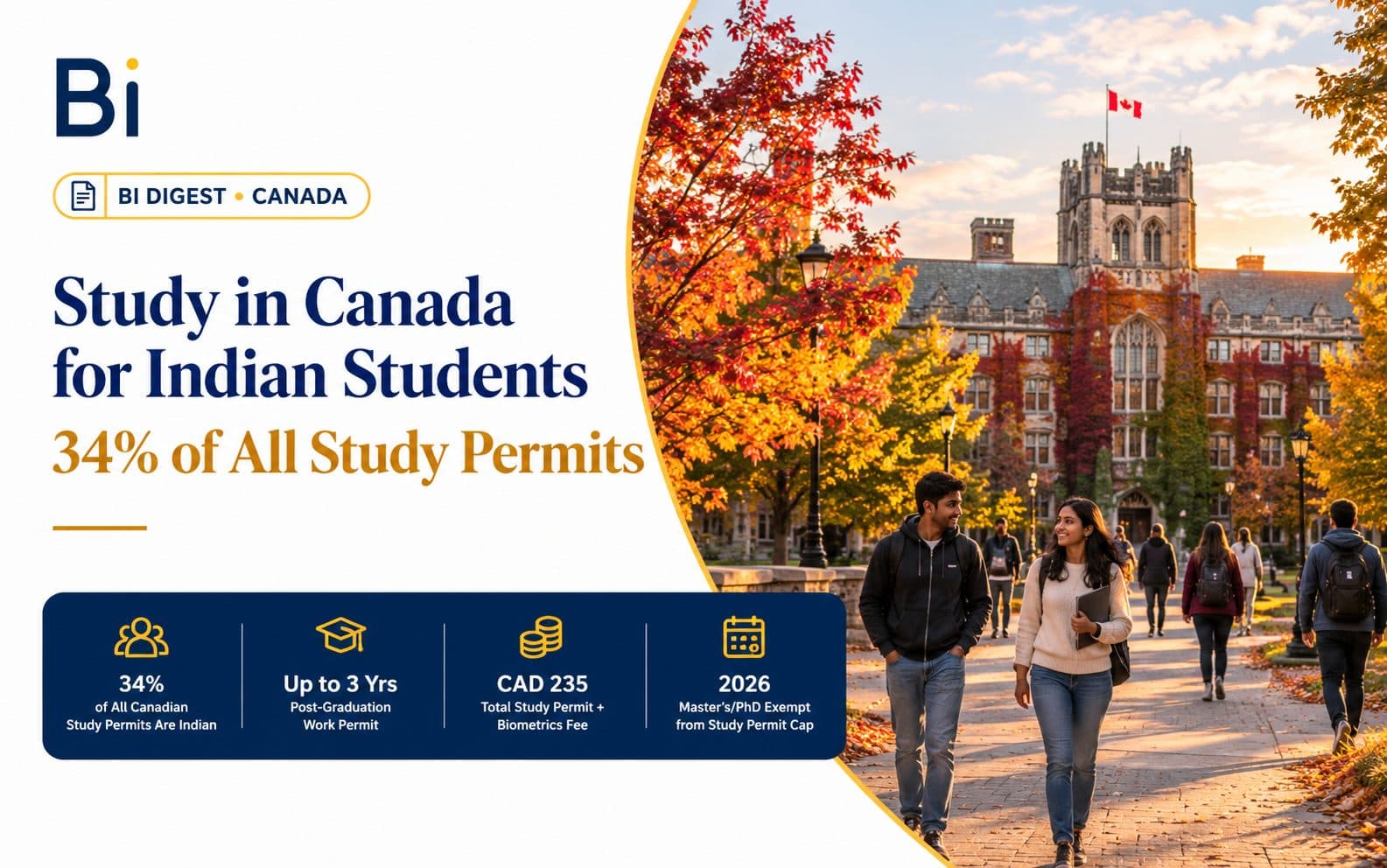
Canada still takes more Indian students than any other single destination — but 2025-26 brought a study permit cap, a higher proof-of-funds bar, and real rule changes. Here's what actually matters before you apply.
By Mandeep Aulakh · Published 30 September 2026
Still the largest single destination for Indian students — with real new limits
Indian nationals account for roughly 34% of all Canadian study permit holders — the single largest source nationality of any country studying in Canada, even after Ottawa tightened intake rules through 2025. No other Big-4 destination (UK, Australia, USA) has a comparable share from any one country.
But 2025-26 genuinely changed the calculus. Canada introduced a national cap on new study permits, raised the minimum proof-of-funds requirement — now CAD 23,448 for a single applicant, effective 1 September 2026 — and tied post-graduation work rights for non-degree (college diploma/certificate) programs to a list of in-demand fields. None of this makes Canada a worse choice — it makes a weak, generic application a much easier one to reject than it used to be. A well-documented application to a public university, in a real field of study, is not meaningfully affected by any of these changes.
The one relief that matters most for anyone reading this with a master's or PhD in mind: from January 1, 2026, master's and doctoral applicants to public Designated Learning Institutions are exempt from the national study permit cap entirely, and don't need a Provincial Attestation Letter (PAL) at all. If you're applying at the graduate level, the 2025 cap headlines you've read mostly don't apply to you.
What it actually costs — five universities, real 2026 fees
Tuition varies enormously by program, not just by university — an MBA and a Master of Data Science at the same school can differ by tens of thousands of dollars. The figures below are official, per-university figures for representative undergraduate and postgraduate programs, verified directly against each university's own fee page as of September 2026 (the same verification pass already live on this site's own university pages).
| University | QS World Rank 2027 | Representative Undergrad Fee | Representative Postgrad Fee |
|---|---|---|---|
| McGill University | #30 | CAD 71,687 (BCom) | CAD 72,524 (Master of Management in Finance, international rate) |
| University of Toronto | #32 | CAD 70,060 (BASc Engineering) | CAD 65,000 (Master's, Financial Economics) |
| University of British Columbia | #45 | CAD 66,678 (BCom) | CAD 58,000 total (Master's, Data Science, 10 months) |
| University of Waterloo | #1 in Canada for Co-op/Engineering | CAD 75,000 (BEng) | CAD 52,000 total (Master's, Data Science & AI, 20 months) |
| University of Alberta | #96 | CAD 49,952 (BEng) | CAD 60,000 total (MBA, 20 months) |
Representative annual tuition, 5 major Canadian universities, verified September 2026
The study permit: cost and process
The study permit application fee is CAD 150, plus a CAD 85 biometrics fee (valid 10 years — waived if you've given biometrics for Canada before) — CAD 235 total for a first-time applicant. This is separate from, and much smaller than, the proof-of-funds requirement (CAD 23,448 minimum for a single applicant, effective 1 September 2026) which you must demonstrate you have access to, not pay as a fee.
Apply through IRCC's online portal once you have an offer letter from a Designated Learning Institution (DLI) — check your specific institution is on the current DLI list before applying, since only DLI-issued offers qualify. Processing time varies by visa office and application volume; check IRCC's own processing-time estimator for a current figure rather than relying on a fixed number, since it moves with application volume.
The Post-Graduation Work Permit (PGWP) — up to 3 years, no sponsor required
This is Canada's single biggest structural advantage over most competing destinations: graduates of eligible programs at a DLI can apply for an open work permit — meaning you can work for any employer, no job offer or sponsor required to start — for up to 3 years.
Since February 15, 2024, master's graduates qualify for a 3-year PGWP regardless of how long the program actually took — a genuinely valuable rule, since it means even a 1-year master's degree can unlock the full 3-year work window, not a permit scaled down to match the shorter program length.
This work experience is also the most direct route into Canadian permanent residency available to a study-abroad graduate — it feeds straight into Express Entry and provincial nominee programs, which weight recent Canadian work experience heavily.
The honest bottom line
Choose Canada if: you want the strongest post-study work-to-PR pathway of any major destination, you're applying at the master's/PhD level (where the 2026 cap exemption removes most of the friction other applicants now face), or you value co-op/applied-learning programs (Waterloo's model in particular) that build paid work terms directly into the degree.
Think harder if: you're applying to a shorter college diploma/certificate program, where the field-of-study PGWP eligibility rules now matter a lot more than they used to — verify your specific program and field against the current PGWP-eligible list before committing, not after you've already enrolled.
Frequently Asked Questions
How much does a Canada student visa cost for Indian students?
The study permit application fee is CAD 150, plus a CAD 85 biometrics fee — CAD 235 total for most first-time applicants. On top of that, you need to show proof of funds of at least CAD 23,448 (effective 1 September 2026, for a single applicant), which is a financial requirement you demonstrate access to, not a fee you pay.
How long is the Post-Graduation Work Permit (PGWP) in Canada?
Up to 3 years. Since February 2024, master's graduates from an eligible program qualify for the full 3-year PGWP regardless of the program's actual length — so even a 1-year master's can unlock 3 years of open work authorization.
Are master's and PhD students exempt from Canada's study permit cap?
Yes, from January 1, 2026. Applicants admitted to a master's or doctoral program at a public Designated Learning Institution are exempt from the national study permit cap entirely, and don't need a Provincial Attestation Letter (PAL) — a real relief compared to the rules that applied through 2025.
What is the minimum proof of funds required for a Canada student visa?
CAD 23,448 for a single applicant, effective 1 September 2026 — up from CAD 22,895 the year before, and from the original CAD 10,000 figure that applied for years before IRCC's 2024 overhaul. The amount is adjusted annually each 1 September in line with Statistics Canada's Low-Income Cut-Off. This must be demonstrated as accessible funds (a mix of bank balances, GIC, and paid first-year tuition is typically accepted), not paid to IRCC directly.
Which Canadian universities are best for Indian students?
McGill (#30 globally, QS 2027) and University of Toronto (#32) are Canada's two highest-ranked, research-intensive options. University of Waterloo is the top choice specifically for co-op-integrated engineering and computer science degrees. UBC (#45) and University of Alberta (#96) round out strong options with lower relative tuition, particularly at Alberta.
Can international students work while studying in Canada?
Yes — study permit holders can generally work up to 24 hours per week off-campus during academic sessions, and full-time during scheduled breaks, without needing a separate work permit, provided your study permit includes the condition allowing off-campus work.
Does a Canadian degree lead to permanent residency?
It's one of the clearest pathways of any major study destination. Post-graduation Canadian work experience (via the PGWP) feeds directly into Express Entry's points system and various Provincial Nominee Programs, both of which weight recent Canadian work experience heavily.
What changed in Canada's study permit rules for 2025-26?
Three main changes: a national cap on new study permits, a higher minimum proof-of-funds requirement (CAD 23,448 as of 1 September 2026), and field-of-study alignment rules that tie non-degree (college diploma/certificate) program graduates' PGWP eligibility to a specific list of in-demand fields. From January 2026, master's and PhD applicants to public institutions are exempt from the cap and the Provincial Attestation Letter requirement.
Sources
34% of all Canadian study permits held by Indian nationals; up to 3-year PGWP; 2026 master's/PhD cap exemption
BNPS International's own verified Canada country guide (already live, built and fact-checked in an earlier session) ↗Master's graduates qualify for 3-year PGWP regardless of program length, effective Feb 15 2024; Jan 1 2026 cap exemption for public-DLI master's/PhD applicants, no PAL required
Confirmed directly, canada.ca — About the Post-Graduation Work Permit ↗Study permit application fee CAD 150 + CAD 85 biometrics = CAD 235 total for a first-time single applicant
Biometrics fee (CAD 85) confirmed directly, canada.ca; CAD 150 study permit fee corroborated across multiple current visa-fee guides ↗Minimum proof-of-funds requirement CAD 23,448 for a single applicant, effective 1 September 2026, up from CAD 22,895 the prior year
Secondary-corroborated (multiple independent 2026-dated immigration-consultancy sources converge on this figure; canada.ca's own updated cost-of-living page could not be reached directly on this pass — recommend a spot-check on the live canada.ca page before publish) ↗2026 cap exemption for master's/PhD at public DLIs, no PAL required
Confirmed directly, canada.ca — 2026 provincial and territorial allocations notice ↗University tuition figures (McGill, Toronto, UBC, Waterloo, Alberta)
Each university's own official fee page — reused from this site's own already fee-verified `universityPages.ts` entries (feeVerifiedDate 2026-09-01) ↗Figures and rules change; always confirm against the official source for your application date.
Have a question this didn't answer?
Every situation is different. Talk to a counsellor for advice specific to your profile, budget, and timeline.