Sample Statement of Purpose: A Full Annotated SOP Template
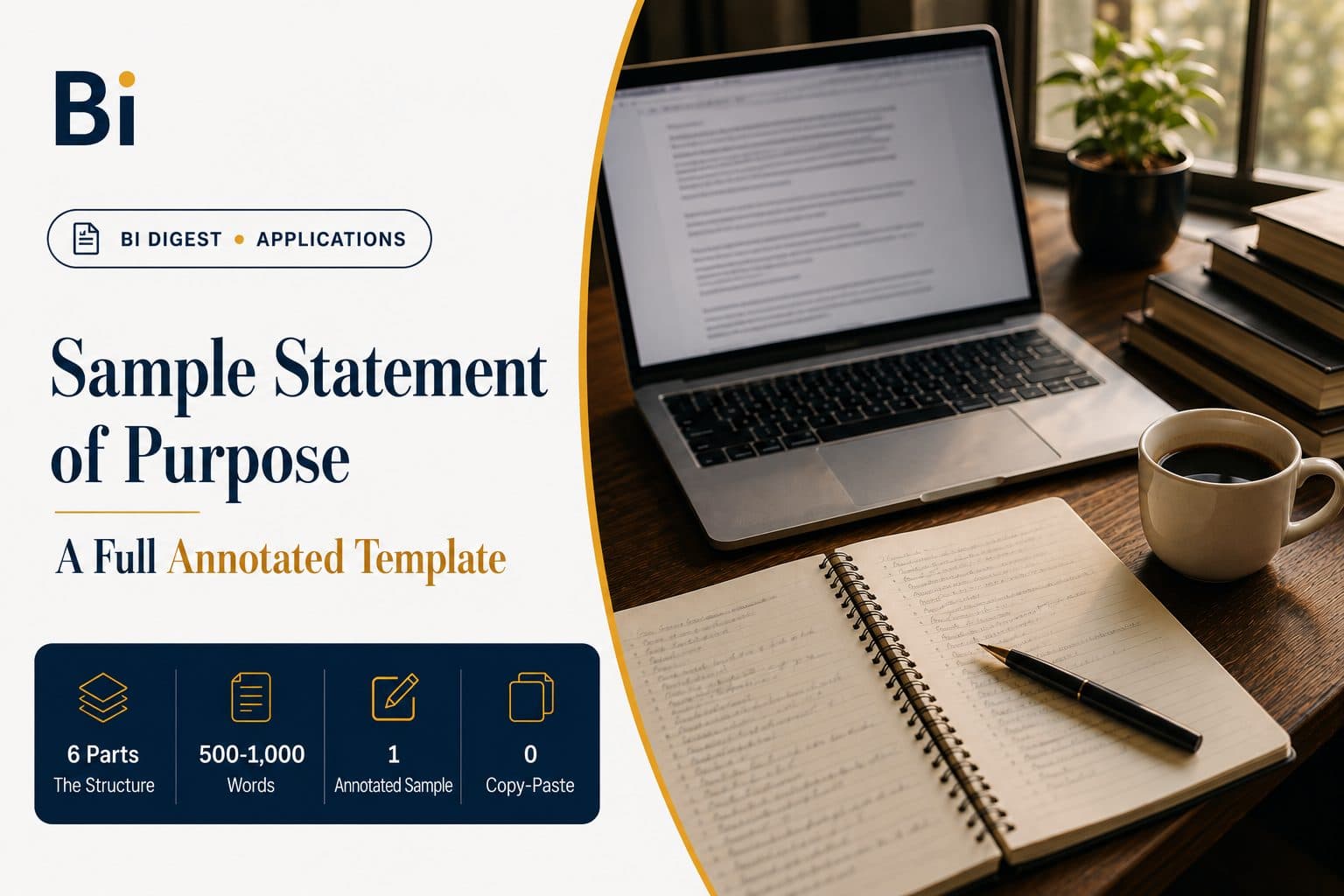
Most SOP samples online are either too generic to learn from or too specific to adapt. Here's a full sample SOP for a Master's application, annotated paragraph by paragraph, so you understand why each part works — not just what to copy.
By Mandeep Aulakh · Published 3 September 2026
Read the structure before you read the sample
A strong SOP for a Master's application almost always follows the same six-part structure, regardless of country or field. Universities read hundreds of these, and a familiar structure isn't a weakness — it's what lets the actual content (your specific reasons, your specific experience) stand out instead of competing with a confusing format.
The six parts: (1) a specific opening that avoids the two most overused SOP openings — a dictionary-style definition of your field, or 'Since childhood, I have been passionate about...' — (2) your academic background and what specifically led you here, (3) relevant experience (internships, projects, research, work) and what you actually learned from it, (4) why this specific program, not just this field in general, (5) why this specific university, backed by something real (a named professor, lab, or course, not 'world-class faculty'), and (6) your career goals and how this degree connects them — specific enough to be believable, not so rigid it sounds like you've already planned every year of your life.
The sample below follows this exact structure. Read the annotations after each part before writing your own — they explain the reasoning, not just the words.
The full sample: an MS in Data Science application
This is a complete, realistic sample — written for a composite applicant, not a real student, so it's safe to study for structure without it representing anyone's actual application. Don't copy sentences directly into your own SOP: admissions offices commonly run submitted SOPs through plagiarism-detection tools, and a matched sample SOP is one of the fastest ways to get an application flagged. Use this for structure and technique, write your own content.
SAMPLE — OPENING: "During my final year of engineering, a professor mentioned in passing that our college's placement dataset — six years of recruitment outcomes — had never actually been analyzed. I spent the next two months building a model that predicted, with 78% accuracy, which students were likely to receive no offers by the December cycle, early enough for the placement cell to intervene. That project didn't just teach me the mechanics of a classification model — it showed me that the hardest part of data science is rarely the algorithm. It's figuring out which question is actually worth answering."
WHY THIS WORKS: It opens with a specific, verifiable story instead of a general statement about the field. The reader learns something concrete about the applicant (built a real model, on a real dataset, with a stated real accuracy figure) in the first two sentences, and the closing line signals maturity — the applicant already understands something most first-year students don't (that framing the question matters more than the tool).
SAMPLE — ACADEMIC BACKGROUND: "My undergraduate degree in Computer Science gave me a strong foundation in algorithms and systems, but it was a single elective in statistical inference, taken almost by accident in my third year, that changed the direction of my interest. I went from viewing data as something a program processes to viewing it as something that has to be interrogated — checked for bias, tested for significance, and understood before it's trusted. I supplemented this interest with two online certifications in applied statistics and a self-directed project analyzing five years of public transit delay data for my city, which I presented at my college's technical symposium."
WHY THIS WORKS: It's honest about how the interest actually developed (an elective 'taken almost by accident') rather than claiming a lifelong plan, which reads as more credible, not less. It also proactively addresses a likely admissions question — 'does this CS graduate have enough statistics background for a data science program?' — with specific, checkable evidence (named certifications, a named independent project) instead of just asserting competence.
SAMPLE — WHY THIS PROGRAM: "[University]'s MS in Data Science stood out for a structural reason most programs I researched don't share: the required industry practicum in the second semester, paired with the Applied Machine Learning Systems course that focuses specifically on deploying models in production, not just building them in a notebook. My placement-prediction project taught me that a model nobody puts into production has no real impact — this program is one of the few I found that treats that gap as a core part of the curriculum, not an afterthought."
WHY THIS WORKS: It names a specific structural feature of the actual program (a real course, a real curriculum design choice) rather than generic praise ('excellent curriculum', 'renowned faculty') that could be copy-pasted into an application to any university. It also links back to the applicant's own opening story, making the whole SOP feel like one coherent argument instead of six disconnected paragraphs.
SAMPLE — WHY THIS UNIVERSITY: "I've followed Professor [Name]'s recent work on fairness-aware recommendation systems, particularly the 2025 paper on mitigating popularity bias in low-data settings — a problem I ran into directly while working with a sparse, six-year placement dataset that almost certainly encodes historical bias I wasn't equipped to formally correct for. I'd welcome the opportunity to take her advanced coursework and, ideally, contribute to her lab's ongoing research in my second year."
WHY THIS WORKS: It names a real professor and a real, specific piece of their published research, and connects it back to a concrete limitation the applicant already ran into in their own project — this is far harder to fake or template than 'I am impressed by the university's world-class faculty and resources', and it's exactly the kind of detail that requires the applicant to have actually done the research.
SAMPLE — CAREER GOALS AND CLOSING: "My goal is to work as a data scientist at an organization where models directly affect real decisions — healthcare access, credit, or public infrastructure — where the fairness and interpretability questions I've started exploring aren't academic exercises but genuine constraints. In the longer term, I'm interested in eventually leading a team that builds these systems responsibly, but I know that requires depth I don't yet have, which is exactly what I'm applying to this program to build."
WHY THIS WORKS: The goal is specific enough to be believable (a stated type of application domain, a stated concern) without over-specifying into a rigid 10-year plan that would sound naive. The closing line also directly answers the implicit question every SOP needs to answer — 'why do you need this degree, specifically, to do what you want to do' — instead of just restating enthusiasm.
How long should a statement of purpose be?
Most universities specify a word or page limit directly in the application portal — always follow that exact figure over any general rule, since it varies by program. As a general guideline where no limit is given: 500-1,000 words (roughly one to one and a half pages, single-spaced) covers the six-part structure above without padding. The sample above runs to about 550 words — proof that the structure doesn't require excessive length to do its job.
The mistakes that get an SOP mentally set aside
Generic praise with no specific evidence — 'world-class faculty', 'state-of-the-art facilities', 'excellent global reputation' — signals the SOP could be sent to any university with the name swapped, which is exactly what admissions readers are trained to notice.
A restated resume instead of a narrative — listing achievements chronologically without explaining what you learned or why it matters to this specific application repeats information the admissions committee already has from your transcript and CV.
An SOP that reads like it was written for a different program or country entirely (a leftover reference to a different university, or generic 'study abroad' language when the same document should be tailored per application) — proofread specifically for this before every submission, not just for grammar.
Frequently Asked Questions
Is it safe to use a sample SOP directly?
No — never copy sentences from a sample SOP into your own application. Admissions offices commonly run submitted SOPs through plagiarism-detection software, and a matched sample is one of the fastest ways to get an application flagged or rejected outright. Use a sample to understand structure and technique, then write entirely original content about your own experience.
How long should a statement of purpose be?
Follow your specific university's stated word or page limit first — it's usually given directly in the application portal. Where no limit is specified, 500-1,000 words (about one to one and a half single-spaced pages) is the standard range for a Master's-level SOP.
What should a statement of purpose for an MS include?
Six parts, in order: a specific opening story (not a generic definition of your field), your academic background and what led you to this interest, relevant experience and what you learned from it, why this specific program (not just this field), why this specific university (ideally naming a real professor or course), and your career goals connected back to why you need this degree specifically.
What's the difference between an SOP and a Letter of Recommendation?
An SOP is written by the applicant, in their own voice, making their own case. A Letter of Recommendation is written by someone else — usually a professor or employer — vouching for the applicant from an external perspective. Universities typically require both because they serve different purposes: the SOP shows how you think about your own goals, the LOR shows how someone who has worked with you assesses your ability.
How is a statement of purpose different from a visa SOP?
A university SOP argues why you should be admitted to a specific program. A visa SOP (required by some countries, including the UK's CAS-linked process) argues that you are a genuine student who intends to study, not immigrate, and typically needs to address funding, ties to your home country, and post-study intentions directly. The two serve different readers and often need different emphasis — see our dedicated SOP vs Visa SOP guide for the full breakdown.
Should every SOP be different for each university?
Yes. The 'why this university' section specifically must be unique to each application — reusing generic language across multiple SOPs, or worse, leaving in a reference to a different university from a previous draft, is one of the most common reasons an otherwise strong SOP gets set aside.
Have a question this didn't answer?
Every situation is different. Talk to a counsellor for advice specific to your profile, budget, and timeline.