

Introduction
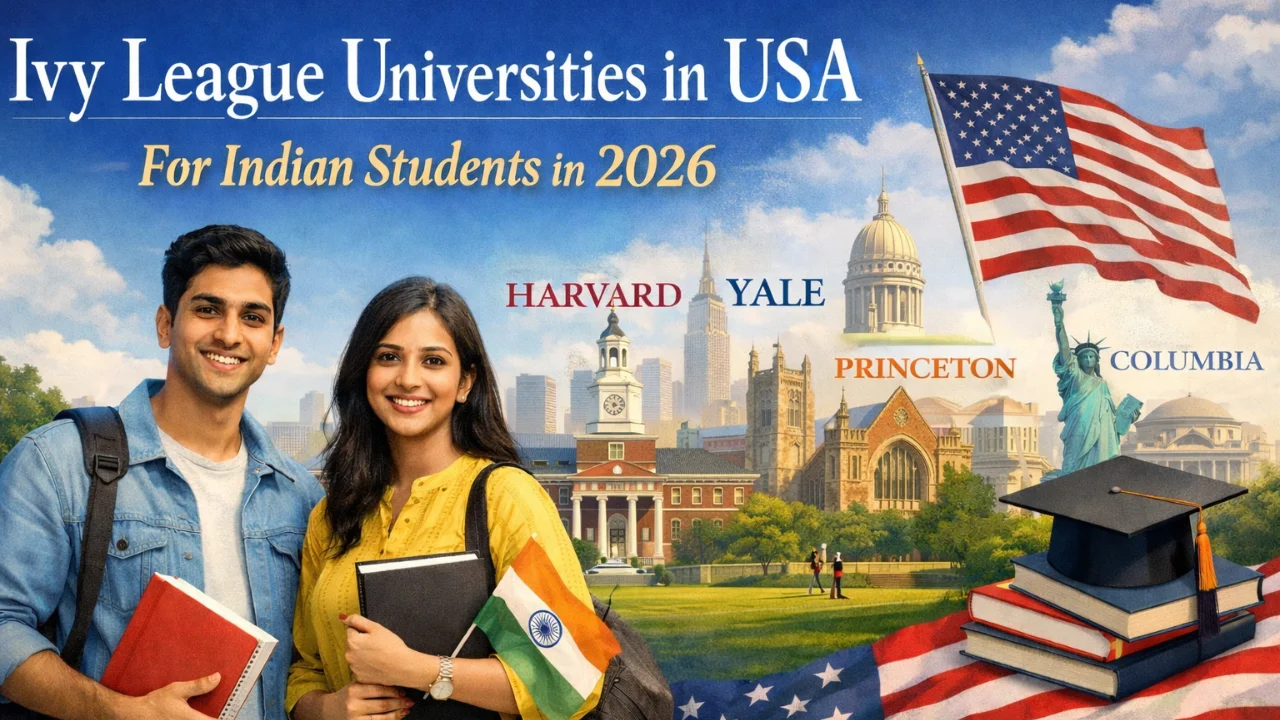
Your quest for an Ivy League University in the US is finally over!
You have reached the perfect space where all your doubts and confusion will puff in thin air.
This blog will be your gem to discover which Ivy League University will see you wearing that black graduate hat!
In order to shape those dreamy aspirations, it is pivotal to first understand what is an Ivy League University and how such an institution can be your road to success.
In this blog, we will be discussing in detail the updated scholarship opportunities, fee structure, comprehensive overview of costs, student life, application process, and more.
So, stay tuned!
And maybe grab your favourite beverage, as no research is complete without the caffeine solace!
Below is the list of Ivy League Universities you can choose from –
Members (alphabetical):
- Brown University
- Columbia University
- Cornell University
- Dartmouth College
- Harvard University
- Princeton University
- University of Pennsylvania (Penn)
- Yale University
What are the Ivy League Universities in the USA?
The Ivy League began in 1954 as an athletic association, but over time, it grew into something far greater — a global symbol of excellence and influence. Today, “Ivy League” signifies leadership, tradition, and access to the world’s most powerful alumni networks.
The Ivy League is a group of eight private universities known for high academic standards and distinctive traditions. Each university defines its academic model and student experience in public-facing pages (linked in each section below) for your easy access and better understanding. Thank us later.
Through the explanation of each university below, you will get to know how curricula work, how undergraduate research is structured, what financial aid policies apply to international students, and how campuses are organized.
So, shall we begin?
Top 8 Ivy League Universities in the USA (from official sites)
Harvard University (Cambridge, Massachusetts)
- Academic structure: Harvard comprises Harvard College (undergraduate), 12 graduate & professional schools, and the Radcliffe Institute for Advanced Study.
- Programs: Browse degrees and majors across Harvard’s 13 schools, including executive and online options.
- Financial aid: Need-blind admissions for all; meets 100% of demonstrated need.
- Takeaway: A sprawling multi-school ecosystem with deep research options and broad program choices to choose from.
Princeton University (Princeton, New Jersey)
- Signature feature: Independent work (junior/senior thesis) is a defining element of the undergraduate experience; broad support for funded research.
- Mission & model: Undergraduate education with an emphasis on independent research is central to the mission.
- Financial aid: Need-blind for international students; meets full need with grants.
- Takeaway: A smaller, research-intensive Ivy with structured undergraduate research at its core.
Yale University (New Haven, Connecticut)
- Residential Colleges: Every first-year student is assigned to one of fourteen residential colleges, creating small communities within Yale College.
- Academics: Instruction across 80+ subjects in the liberal arts, sciences, and engineering within Yale College.
- Financial aid: Need-blind for all; need-based Yale Scholarship model.
- Takeaway: A renowned liberal-arts foundation with an embedded residential college system.
Columbia University (New York City, New York)
- Core Curriculum: For 100+ years, the Core has been the defining element of a Columbia College education, emphasizing shared texts, discourse, and breadth.
- Financial aid: Need-aware for international applicants; if admitted with funding, Columbia meets 100% of demonstrated need.
- Takeaway: A rigorous Core Curriculum + NYC immersion and access.
University of Pennsylvania (Philadelphia, Pennsylvania)
- Wharton (Undergraduate): A four-year business education granting a BS in Economics with concentrations; multiple coordinated dual-degree options (e.g., Huntsman Program).
- Financial aid: Need-aware for international applicants; meets 100% demonstrated need for those admitted.
- Takeaway: Cross-school flexibility with a world-leading business program at the undergraduate level.
Cornell University (Ithaca, New York; NYC; global sites)
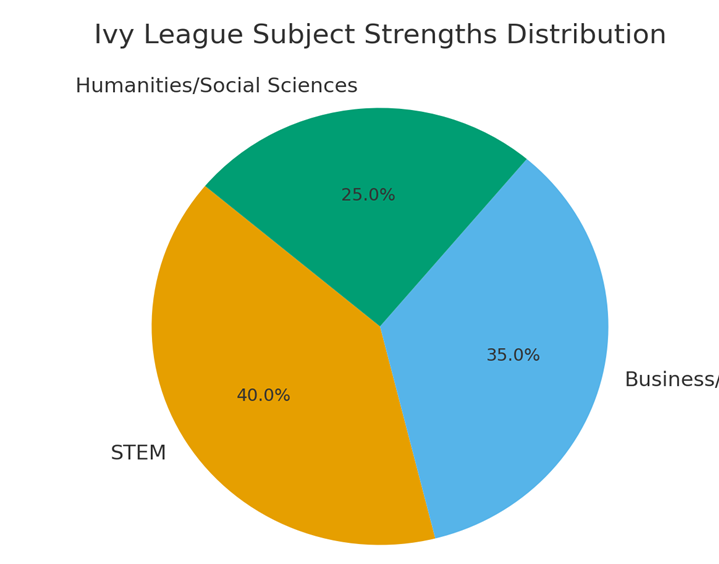
- Breadth: Cornell spans multiple colleges and schools (e.g., CALS, Engineering, Arts & Sciences, SC Johnson College of Business, AAP, ILR, Brooks School of Public Policy).
- Locations: Main campus in Ithaca, plus Cornell Tech in New York City and additional sites worldwide.
- Financial aid: Need-aware for international applicants; meets 100% demonstrated need for those admitted.
- Takeaway: A broad research portfolio with unique strengths spanning STEM, agriculture, business, architecture, and labor relations.
Brown University (Providence, Rhode Island)
- Open Curriculum: Students design a personalized, rigorous program—no core requirements—encouraging exploration and intellectual risk-taking (in place since 1969).
- Financial aid: Need-blind for first-year international applicants starting with the Class of 2029; meets full demonstrated need (transfers remain need-aware).
- Takeaway: Freedom to architect your degree, backed by advising to create academic depth.
Dartmouth College (Hanover, New Hampshire)
- D-Plan (quarter system): A flexible, year-round calendar (four 10-week terms), allowing customized study, research, and off-term experiences.
- Financial aid: Need-blind for international applicants and meets 100% of demonstrated need (policy expanded to all international citizens beginning with the Class of 2026).
- Takeaway: A close-knit, undergraduate-focused Ivy with notable schedule flexibility via the D-Plan.
Ivy League Universities in the USA Ranking – QS & USA News Ranking
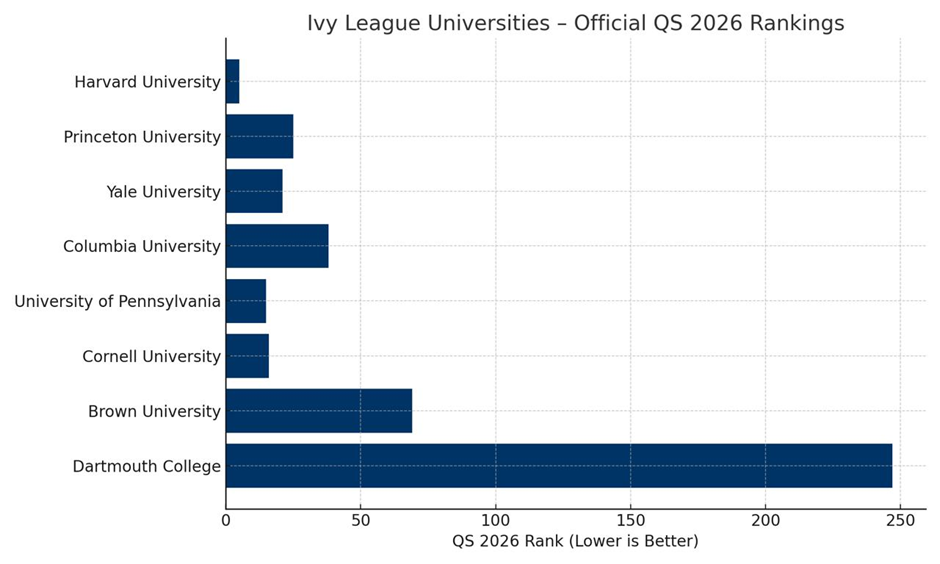
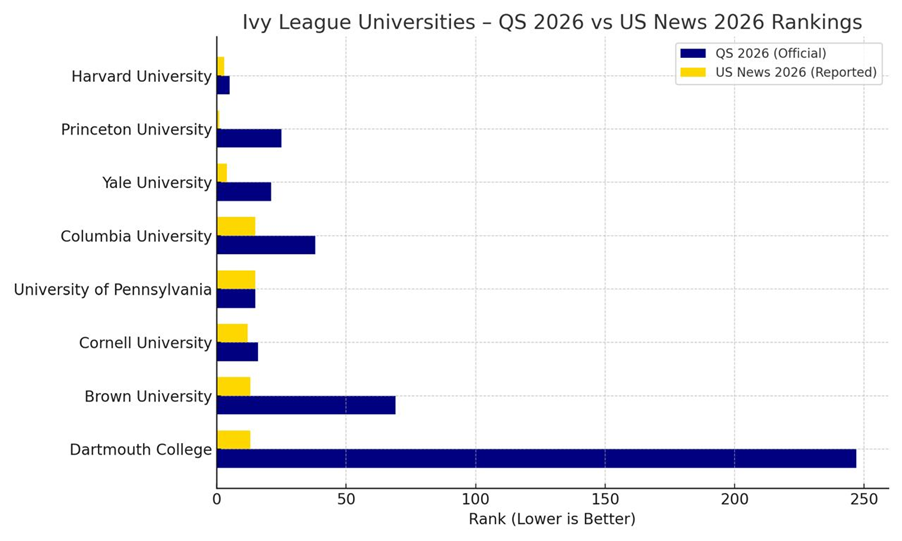
Below is a detailed table showing that Ivy League universities in the USA dominate the world rankings year after year. One shows the global ranking, and the other shows its strong presence in the United States. When taking a closer look, Harvard, Princeton, and Yale continue to lead globally across all parameters — research, employability, and innovation.
| University | QS 2026 Rank | US News 2026 Rank |
| Harvard University | 5 | 3 |
| University of Pennsylvania | 15 | 7 |
| Cornell University | 16 | 12 |
| Yale University | 21 | 4 |
| Princeton University | =25 | 1 |
| Columbia University | =38 | 15 |
| Brown University | 69 | 13 |
| Dartmouth College | =247 | 13 |
Scholarships in the USA for International Students – Ivy League University (Official Policies)
Ivy financial aid is not uniform. Some institutions are need-blind for international applicants (admissions don’t consider ability to pay), while others are need-aware but meet 100% of demonstrated need for those admitted. Here’s what each university says on its site:
- Harvard – Need-blind for all applicants and meets 100% of demonstrated need for admitted students.
- Princeton – Need-blind admission for international students and meets full need with grants (not loans).
- Yale – Need-blind for all applicants and provides need-based aid only.
- Columbia – Need-aware for international students; if admitted with funding, meets 100% demonstrated need.
- Penn (University of Pennsylvania) – Need-aware for international applicants; meets 100% demonstrated need for those admitted.
- Cornell – Need-aware for international applicants; meets 100% demonstrated need for those admitted.
- Brown – Transitioning to need-blind: beginning with the Class of 2029 (matriculating Fall 2025), Brown is need-blind for first-year international applicants; meets full demonstrated need for admitted students. (Transfers remain need-aware.)
- Dartmouth – Need-blind for international applicants and meets 100% of demonstrated need (policy expanded to all international citizens starting with the Class of 2026).
To make it easy for you and to summarise, if you are someone who looks for affordable studies, and you want your financial need not to affect admission, the official pages confirm need-blind policies at Harvard, Princeton, Yale, and Dartmouth.
However, at Columbia, Penn, Cornell, and (for now) most Brown cohorts, admissions can consider need—but admitted students receive packages that meet 100% of demonstrated need under stated policies.
Choosing “Your” Ivy (Official-Feature Decision Framework)
1) Academic Model (curriculum & structure)
- Want a shared canon and seminar-style discourse? Consider the Columbia Core.
- Want maximum academic freedom? Brown’s Open Curriculum.
- Want undergraduate research backed up? Princeton’s independent work model.
- Want a flexible calendar to blend internships, study abroad, and research? Dartmouth’s D-Plan.
2) City vs Campus
- If you want an urban immersion with immediate industry access: Columbia (NYC), Penn (Philadelphia), Cornell Tech (NYC).
- If you crave Tranquil college towns with tight communities: Princeton, Dartmouth, Cornell Ithaca, Brown, Yale.
3) Financial Policy Fit
- If you need admissions not to consider your ability to pay: Harvard, Princeton, Yale, Dartmouth (need-blind for internationals).
- If you’re applying where admissions are need-aware but aid is robust once admitted: Columbia, Penn, Cornell, Brown (transfers; need-blind begins Class of 2029 for first-years).
Application Logistics (Use Official Pages Each Year)
Deadlines and requirements can change; always verify on the current admissions page for each school.
- Harvard (International Applicants) – policies & process.
- Princeton (International Students) – admissions and full-need aid.
- Yale (International Applicants) – need-blind admissions, need-based aid.
- Columbia (International Aid) – need-aware policy; meeting full need for those admitted with funding.
- Penn (International Aid) – need-aware; 100% need met for those admitted.
- Cornell (International Applicants) – need-aware admissions; full need met if admitted.
- Brown (International Financial Aid) – move to need-blind for Class of 2029; full need met.
- Dartmouth (International Students) – universal need-blind & 100% need met.
Testing: Most universities outline current SAT/ACT policies on their official admissions pages—check each school’s Testing or First-Year Applicants page for the cycle you’re applying to (requirements may differ by program and year).
Student-Life & Academic Flavour (Straight from the Source)
- Yale’s Residential Colleges create a built-in community for all four years.
- Columbia’s Core cultivates campus-wide dialogue via shared courses.
- Princeton’s Independent Work emphasizes faculty-mentored research and theses.
- Dartmouth’s D-Plan lets you personalize when you’re on campus vs. off (research, internships, abroad).
- Harvard’s multi-school ecosystem gives undergrads proximity to graduate schools and research institutes.
- Penn’s Wharton provides a BS in Economics with concentrations and multiple dual-degree pathways.
- Cornell’s seven undergraduate colleges span agriculture, engineering, arts & sciences, business, architecture/art/ planning, ILR, and public policy.
- Brown’s Open Curriculum enables you to architect your path without core requirements.
Ivy League Universities Vs “Other Elites”—How to Compare
Rather than relying on third-party rankings, use official university features to make apples-to-apples comparisons: curricula (e.g., Columbia’s Core, Brown’s Open), research structures (Princeton’s independent work), calendar flexibility (Dartmouth’s D-Plan), program depth (Wharton at Penn), and campus setting (urban vs. college town). Every claim in the snapshots above links to the university’s page, so you guys can validate and dive deeper!
2026 Application Playbook (Official-Page Workflow)
- Shortlist by model + policy: Align curriculum (Core/Open/Research/D-Plan) and financial policy (need-blind vs need-aware). Sources are attached above.
- Confirm current cycle requirements: Check each school’s official International Applicants page for deadlines, testing, forms (CSS Profile, etc.). Sources are attached above.
- Build your narrative: Use program-specific pages (e.g., Wharton concentrations) to anchor “Why us?” essays with official details.
- Run costs through calculators: Use the university’s own calculators/COA pages; take into account whether they meet full need.
- Submit complete, accurate documentation before each school’s stated deadlines.
Conclusion: Where Strategy Meets Verified Facts
Now that you have garnered key insights into what Ivy League universities have in store for you, it is time to start executing your career plans! And so, BNPS International can help you translate these verified features into winning applications—program-specific positioning, policy-aware school lists, and airtight documentation that meets each university’s stated requirements.
The Ivy League is not just prestige — it’s writing your own story on the world’s biggest stage. But the question isn’t just ‘Can I get in?’ It’s ‘Where will I thrive?’
That’s where BNPS International steps in:
- Personalized 1:1 guidance
- Free university shortlisting
- Craft SOPs and essays that win admits
- Guide scholarships and aid applications
Book a free consultation right away with BNPS International and turn your ambition into an admit letter from the world’s most powerful universities.
FAQs
The term Ivy League refers to a group of eight prestigious Ivy League universities in USA known for academic excellence, selectivity, and long-standing tradition. The name didn’t start as an academic label — it originated from early 20th-century college sports coverage.
There are 8 Ivy League schools in the USA, not 12. The Ivy League is an official athletic and academic association made up of eight elite Ivy League universities in USA located in the northeastern United States.
Stanford is not an Ivy League school because it is not part of the Ivy League group, which includes only eight Ivy League universities in USA located in the northeastern United States. The Ivy League began as a sports conference, and Stanford, being in California, was never part of it.
There is no single “most prestigious” Ivy League university, as all Ivy League universities in USA are highly respected. However, Harvard University is often considered the most prestigious due to its global reputation, long history, influential alumni, and strong rankings.










One Response
Thi is a great article no doubt about it, i just started following you and i enjoy reading this piece. Do you post often ? we have similar post on the german best freelancer platform called https://webdesignfreelancerdeutschland.de/ you can check it out if you want. Thank you