ESSEC Business School: Fees, Ranking, and Admission Requirements
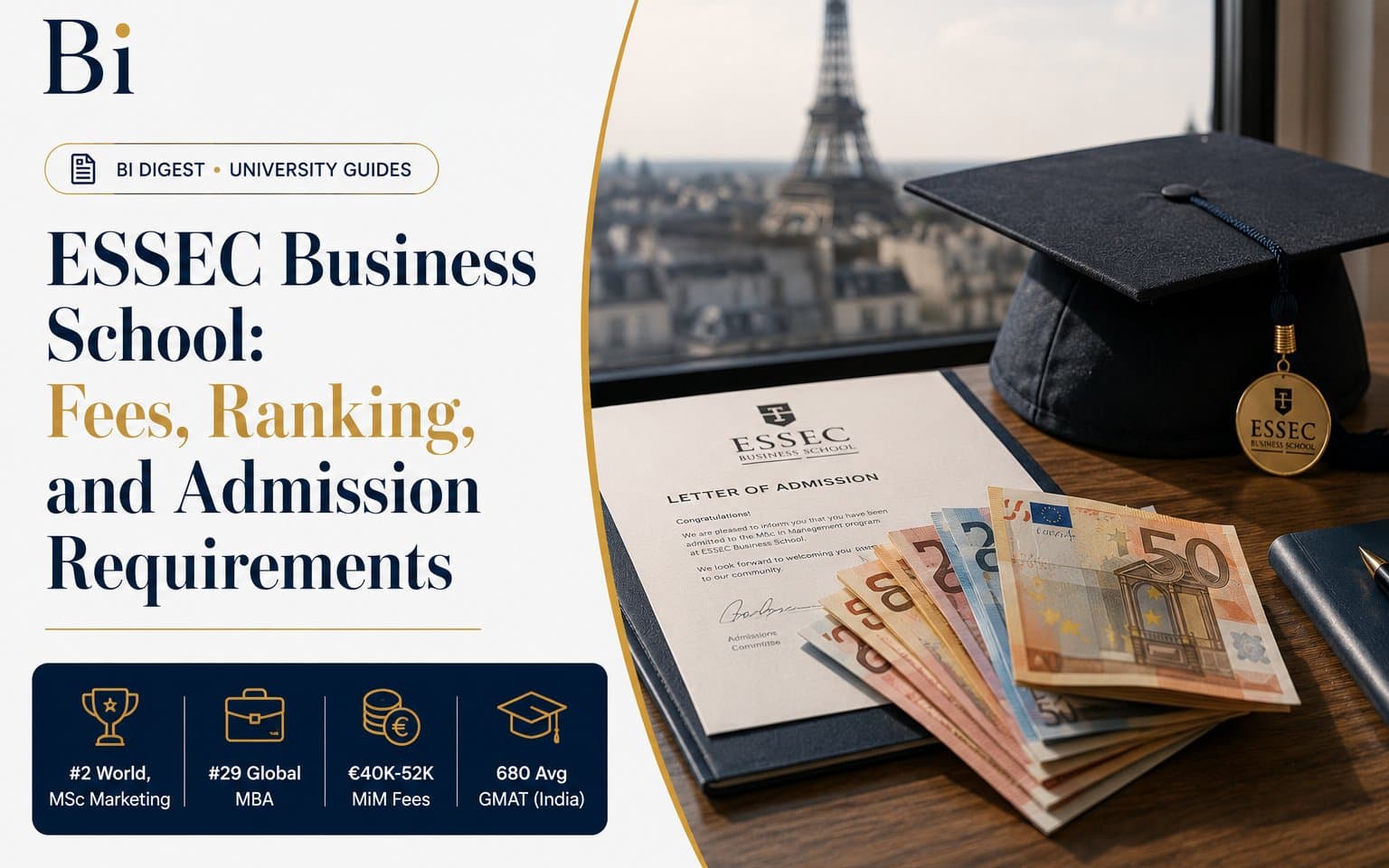
ESSEC's MSc in Marketing ranks #2 in the world, its Global MBA sits at #29, and Indian applicants average a 680 GMAT with no work experience required — but the fee structure genuinely differs by track, campus, and program in ways that most comparison pages flatten into one number.
By Mandeep Aulakh · Published 26 August 2026
What ESSEC actually costs, by program and track
ESSEC's fee structure splits meaningfully by program and, for the flagship Master in Management, by which track you choose — a distinction most cost comparisons flatten into a single number.
| Program | Fee | Notes |
|---|---|---|
| Master in Management (MiM) — intensive 1-year track | €40,000 | Faster completion, same degree |
| Master in Management (MiM) — flexible 2-year track | €52,000 | For non-EU students choosing the extended schedule |
| Global MBA | €49,500 | 2025-26 intake figure |
| Singapore campus application fee | SGD 100-120 | Separate from Paris/Cergy admissions |
ESSEC Business School fees, 2026
Where ESSEC actually ranks, and why that varies by program
ESSEC's Global MBA sits at #29 in the QS Global MBA Rankings 2026 — a solid, credible position, but not the number that makes ESSEC genuinely stand out. That's its MSc in Marketing, ranked #2 in the world by QS — a specialist program ranking that beats the school's own overall reputation, and the kind of detail a generic "ESSEC ranking" search often misses entirely because it defaults to reporting only the overall/MBA figure.
The practical implication: which ESSEC ranking matters to you depends entirely on which program you're applying to. Citing the MBA rank for a marketing applicant, or vice versa, understates the actual credential you'd be earning.
Admission requirements — and what's different for Indian applicants specifically
For the Master in Management, ESSEC expects a completed bachelor's degree, GMAT or GRE scores (the average admitted GMAT runs 660-670), a statement of purpose, letters of recommendation, a CV, and an English proficiency score (IELTS/TOEFL) for non-native speakers. Singapore-campus applications specifically ask for two references — ideally one academic and one professional — alongside the standard document set.
For the Global MBA, Indian applicants should target a GMAT of at least 615 to be competitive for selection; 585 is treated as the practical floor rather than a safe target. ESSEC's Indian applicant pool currently averages a 680 GMAT and a 7.5 GPA, with no prior work experience required for the MiM track — worth knowing if you're weighing ESSEC against MBA programs that do gate on work experience.
ESSEC runs a genuinely different admissions calendar depending on campus: the Singapore Global MBA operates on rolling admissions, reviewing applications continuously rather than against fixed deadlines, while the Paris/Cergy programs run on a more conventional cycle. Confirm which calendar applies to your specific program and campus before building your application timeline.
Scholarships and the actual India-specific detail worth knowing
ESSEC offers a scholarship specifically available to Indian applicants that can cover up to 100% of tuition, and — this is the detail most comparison content leaves out — it doesn't require a separate application. If you're admitted, you're automatically considered for it as part of the standard admissions process, rather than needing to submit a distinct scholarship application on top of your program application.
With roughly 12% of ESSEC's student body being Indian and an alumni network of around 650, the school has a genuinely established Indian applicant pipeline rather than being a newer or less-tested destination for Indian students specifically.
Frequently Asked Questions
How much does ESSEC Business School cost?
It depends on the program and track: the Master in Management runs €40,000 (intensive 1-year track) to €52,000 (flexible 2-year track for non-EU students), and the Global MBA is €49,500 for the 2025-26 intake.
What is ESSEC's QS ranking?
ESSEC's Global MBA ranks #29 in the QS Global MBA Rankings 2026, while its MSc in Marketing ranks #2 in the world — a specialist-program ranking that often outperforms the school's general reputation.
What GMAT score do I need for ESSEC as an Indian applicant?
For the Global MBA, target at least 615; 585 is the practical minimum, not a safe target. ESSEC's actual Indian applicant pool currently averages a 680 GMAT.
Does ESSEC require work experience for admission?
Not for the Master in Management track — no prior work experience is required for Indian applicants specifically. Work experience expectations differ for the Global MBA.
Is there a scholarship for Indian students at ESSEC?
Yes — an Indian-applicant scholarship that can cover up to 100% of tuition, automatically considered as part of your regular admissions application, with no separate scholarship application required.
What is the application fee for ESSEC Singapore?
SGD 100-120, separate from the Paris/Cergy campus admissions process.
Sources
QS Global MBA Rankings 2026 (#29) and QS MSc Marketing ranking (#2 world)
QS World University Rankings (TopUniversities.com) ↗ESSEC official program and admissions information
ESSEC Business School, official site ↗Figures and rules change; always confirm against the official source for your application date.
Have a question this didn't answer?
Every situation is different. Talk to a counsellor for advice specific to your profile, budget, and timeline.